Saturday, August 29, 2020

Remote Learning: Movement Breaks

Hey teachers! :) Don’t give up your movement breaks when remote learning is the model you’re working in! We KNOW how important breaks are for keeping attention focused and there are so many options that are easy to use  ... redeploy strategies you’ve used in the classroom and just tweak them a little bit! 

Establish routines that include movement for starters, transitions, and wake-up, shake-up times. :) 

Starting out your day, instead of roll call, have Make Your Move - when they hear their name, they make their signature move - get some wiggles out before sitting down at the screen. Or try a rhyme game ... “If your name rhymes with _____ , do a dance!” This is a fun way to get everyone interested and on task, and sneak in a little rhyming lesson.

For transitions in the virtual classroom, when you want to switch subject matter or get new supplies out, use a YouTube or a class song to get everyone moving and set a time limit. Try “We Can Count to 100” on YouTube to count up, clean up and regroup (while also getting LOTS of practice counting all the way up to 100.) You could use this for “bio-breaks” also, while remote learning, so everyone isn’t hopping off at odd times.   

When you see that attention is waning or bodies are getting twitchy, have a cupcake or muffin tin ready with movements taped in the bottom and a big pompom. Make a show of tossing the pompom high so it lands in one of the cups, and have your students do whatever comes up, counting to 10. Once you do one or two, slide back into your lesson. 

For an alternative, try a game of Follow my Move, where students take turns choosing a stretch, exercise or dance move and everyone follows, while counting to 5 or 10. ( More counting practice!) Spacing this out throughout your screen time, using popsicle sticks with kiddos names, will keep them wondering who’s next ....

Using popsicle sticks of your own to draw or label a movement, stretch, activity is also a great way to keep them organized and make sure you have LOTS of options during your on-air time. There are even sets you can find on teacher supply websites if you want to go that route. 

For littles, a good old fashioned ABC March around individual spaces gets a little percussive movement in to get the wiggles out. Really get silly with how hard you march and lift those knees! Acting out simple finger plays with the whole body is effective for getting the blood flowing and minds on task, while highlighting rhyming or counting :) Think 5 Little Monkeys or The Itsy-Bitsy Spider with LARGE hand and arm movements ...

Transitions could also include a little Teacher I Spy! incorporating shapes and colors, or a more movement - oriented “Find Me ...” where the student has to bring an object back to the screen that is a particular shape, color, or whatever. If you’re learning about numbers, make it “Find me 8 of something small ...” These brief movement breaks will incorporate learning, but allow movement - win, win! 

Have fun! 


Thursday, August 27, 2020

Q Camp: Getting Some Final Summer Fun In!


It's getting close to the end of the summer here and there are still many restrictions in place. Looking for at-home things to do? Here are some links to throwback posts that gather some fun activities together for you :)

#1: One favorite, which is low to no-cost, is "painting" with water out on the hard pavement - sidewalks, driveways, whatever you have :) Here's a link to fun water painting activities:

https://makeearlylearningfun.blogspot.com/2015/08/water-painting-fun.html


#2: Plan some food fun for a rainy day :) Playing with food is usually discouraged but, using what you have in the house, you can figure our some fun "lessons" that encompass math, art, science, etc.

https://makeearlylearningfun.blogspot.com/2015/08/an-apple-is-not-just-apple.html


#3: Literacy for the win! Look for a great book to build a fun activity with! Remember, YouTube can help out with finding books, if you don't have it or don't want to mingle to get it! Googling images will put the cover pics right in front of your child :) It's great when interest in a story generates an extension activity - check this post out for some literacy and small-motor fun!

https://makeearlylearningfun.blogspot.com/2018/08/books-to-love-commotion-in-ocean.html


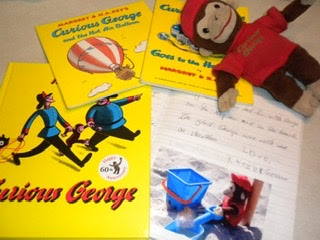
#4: Character book bags can be so much fun! Team up with a few friends to try out this activity - friends who haven't seen each other or might be remote learning might enjoy this interaction by dropping off and circulating a character or two :)

https://makeearlylearningfun.blogspot.com/2011/08/character-book-bags.html     


#5: This post, entitled "Summer Fun!," gives you a bonus - 10 more ways to extend your summer fun!

https://makeearlylearningfun.blogspot.com/2011/07/summer-fun.html


End your summer with a great week! And - have fun!!


Saturday, July 18, 2020

Q-Camp: Plans for Tired Parents :)

This 2020 is an unusual year! You may be running out of ideas to keep your kiddos busy and engaged, which BTW is always ok - because children do their best work when it is born out of a quest for SOMETHING TO DO!!

But still, it's already been a long spr-ummer already, right?!? So, kids being kids ... they (and you!)  are still looking for stuff to do :)

I've tried to group some old posts together to make it easier to do a week's worth of fun and interesting activities with, hopefully, the kiddos doing most of the "work"! 

Day 1: Click here for some tips on fun Outdoor Play - using what you have to build and play on an obstacle course will get your child's creative juices working and have them think about everyday objects in new ways ... and it's great exercise! They can redo it again and again, practicing good social skills (if they have a partner) and design skills. Of course, some supervision is needed to ensure safety :) Don't pass up everyday opportunities for sidewalk curb balancing and hill rolling :)


Day 2: Let your kiddos experience Math concepts in a whole new way - Math with Water Play - great for a warm, dry day :) Let your kiddos collect an assortment of "tools" from around the house and see what happens. Maybe with a little starter exercise, they will take the play in new directions :)


Day 3: A little reading goes a long way, depending on your book choice. Reading to cool off is great for any day - rain or shine! You can cozy up for some great illustrations, and fun, silly words, but be ready to have your kiddos act out the shakey-shakey part :) Acting out and retelling stories are a great tool for comprehension, so play away!


Day 4: Mail Call! Use those rainy or too-hot days to craft some mail for relatives. Great way to reach out in these isolated times :) and children of all ages an abilities can participate! Younger friends can draw a picture and olders can write as best as they are able. These cards and letters are sure to be treasured and - maybe, just maybe, they'll write back!!


Day 5: Ocean Animals are always fun! Check out these simple craft ideas and great reading options - you can usually find titles on YouTube if you don't have access otherwise :) Pairing crafts with stories extends the literature and helps to solidify the story for young readers :)


Have fun!! 


Saturday, May 9, 2020

Remote Learning: Growing Things (With What You Have at Home!)


Want to grow something and show your children at home the process?

No seeds? No problem!!

Don't despair if the sunflower project you always do in the Spring isn't able to work with Remote Learning! Look around at what you (and your students!) already have at home - you'll be surprised what you (and they) can do when you start thinking outside the box :)


Soon after we realized we weren't going back to the classroom anytime soon, I looked around at what I had - in my fridge, my pantry, on my block ...

The first thing I tried was rerooting romaine lettuce. I had a package of lettuce with the stalk part still attached and I had seen a YouTube video showing how to regrow the lettuce. I can't believe how simple this was! Just cut the lettuce about 1 1/2 inches from the end and take the stem piece and set in water in a small container. Overnight, I could see the regrowth. Change the water daily and within a week or two, you'll see roots start to appear. Plant in dirt and watch it grow!


Seeds from an apple were next, after eating it, of course. I put the seeds into a sealed plastic bag in the sunlight, with a small, damp paper towel and waited to see what would happen. This took longer, but after about 7-8 days, roots and a stem started to appear. A few days later, it was transplanted into dirt and continues to grow :)


Look around your environment, too, not just in the house! These "helicopters" fall from a tree near me every year, so into a bag they went, and .... after two weeks (patience!), a small root system was kicking in!


Carrot greens can be grown from the tips of carrots - good for seasoning and garnishing :)


To grow potatoes, I cut a section of a potato that had some growth at the eye, and put that in a plastic bag, too. I left it in a sunny window, and forgot about it ... until this root system caught my eye :)


No seeds, no problem! You can teach and they can learn - using things that are already around in the home!

Have fun!


Wednesday, April 22, 2020

Remote Learning: Look for Sight Words All Around!

Part of learning to read is to quickly recognize some words - the words we call "sight words." Each grade level has an expected list, and each class does things a little differently, but there are lots of small, simple words your child will begin to recognize, especially with fun ways to practice them :)

One resource that is available to you at home is the use of what we call "environmental print." It's the print that you see on packaging, newspapers, magazines, signs, etc. Before you throw away your recyclables, I have a fun "game" for you to play at home :)

Show your child the box or paper, and see if they can find any words that stand out, either alone or as part of (a chunk of) another word .... let's call it a WORD HUNT! Once you've found something, cut it out! I found all these words on my Raisin Bran Crunch box this morning, before I recycled the rest  :)


For another step, you could tape or glue these words onto index cards, or cut up cardboard (use the flip side of the box!) and you have brand new sight word cards! If you find matching pairs, you could do WORD MATCH! I found all of these - I know there are some matching words in this pile!


SILLY SENTENCES is the next game ... arrange the words in sentence lines to try to make sentences. Sometimes they make sense, sometimes they are just silly!! You might have to make some additional people, place or thing (noun) cards or action (verb) cards to form some complete sentences. Let your child draw pictures and help them sound out the corresponding words, so then they can use these when they have sentences to write for assignments.


Most of all, they will get used to looking for these words in the environment, tuning into literacy all around, and having fun with it!


Tuesday, April 21, 2020

Remote Learning: Math - Use What You Have!

Sometimes Math concepts are hard for our little guys and we have to look through their eyes to find ways to make it all make sense. Making it fun is always best, as is applauding small successes as steps along the way :)

In these times of being home during learning times, we have to be even more flexible in how we approach "lessons" :) Look around with fresh eyes for available tools already in your home :) Use things that you find to make math lessons more concrete. For starters, if your child benefits from using tactile methods of teaching, pull out a deck of cards and rustle up some old game pieces.

Get out your playing cards for a simple game, that will explore counting, ordering, and more and less.


Each player gets a stack of cards and turns over one at a time (like the old War game). Each player takes a turn to count the objects (diamonds, hearts, spades or clovers) on their card and touches the numeral in the corner of the card, saying the number. Then, use math language like "most," "more," "less'" and "least." e.g. "I have 9 and you have 5. I have more than you."

Another form would be to lay out three or four cards, count them each up and order them, naming them as "most" and "least." If your child guesses correctly, they get the cards. Getting these concepts down with smaller, one-digit numbers will be to your child's benefit, before moving on to larger numbers. Down the road, you can make higher number cards from index cards, and play with them.

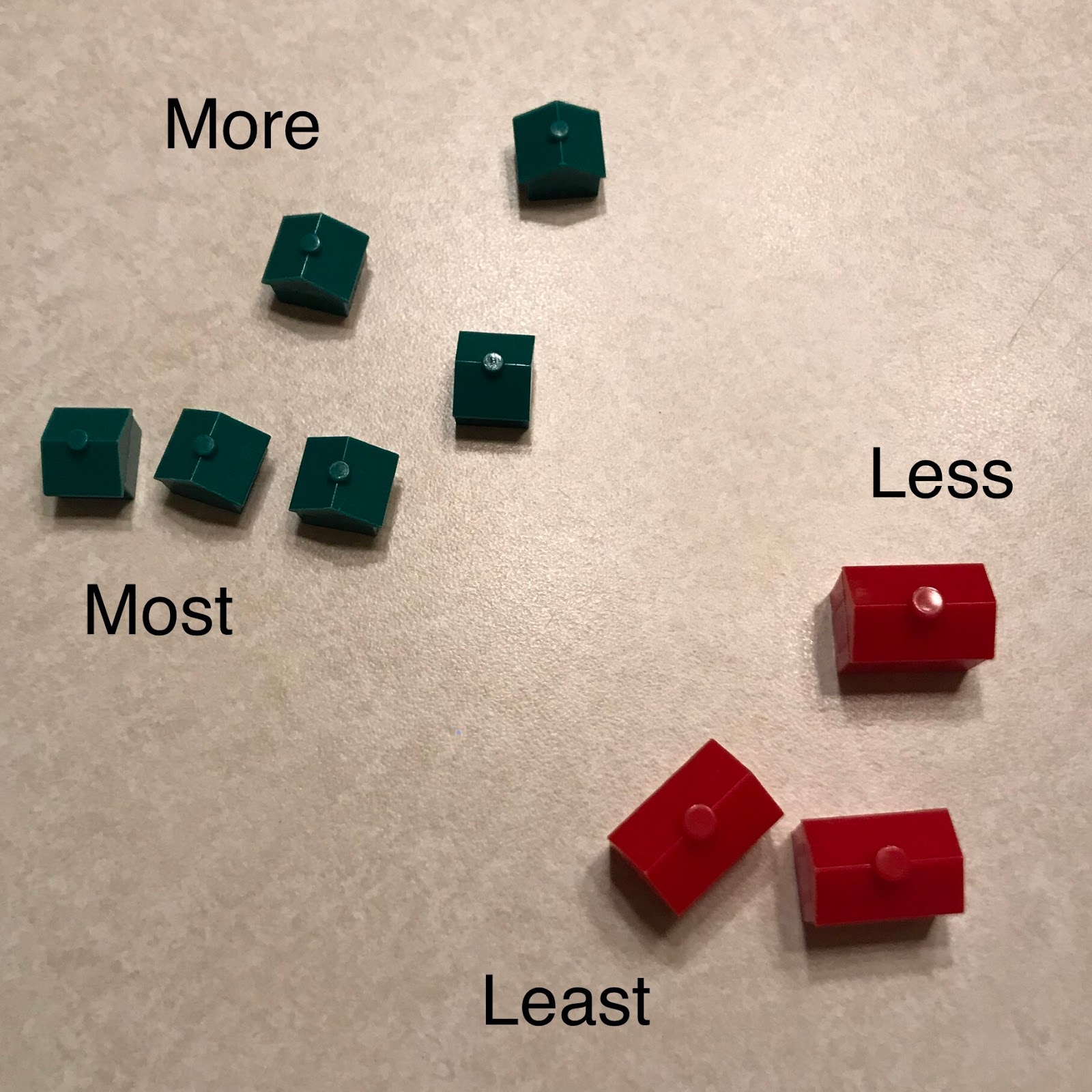
Find an old Monopoly game, or another game with multiple pieces, to use them as your own "math manipulatives." Grabbing amounts of green houses and red hotels, sorting them and finding the totals, will help your child with those skills. Then, add in the math language of "most" and "least" to bring those concepts home :) You might have other toys or games around that can be repurposed for these lessons. Any time you can engage your child in moving, finding, collecting - this will help them learn.

In our house, buttons were always a fun manipulative, as were popsicle sticks. As a teacher and crafter, popsicle sticks were easy to store, and fun to explore with. In our Kindergarten classroom, we used them to count the days of the year, making "bundles" when we reached a group of ten.

Trying this at home may solidify the concepts of higher numbers for tactile learners ... 5 "bundles" (or tens) and 2 "extra" or "all by themselves" (or ones) would be 52. To compare higher numbers to find out "most" and "least," making bundles and extras and touch each one as you count. Your child may understand these bigger numbers better when they can see quantities with their eyes and touch them with their fingers.

By playing with the numbers using games and game pieces, and writing down/matching with corresponding numerals, math becomes more concrete!

And, more fun!


Thursday, March 26, 2020

Remote Learning: At-Home Literacy (Fun!) Challenge

Looking for ways to help your child branch out in their literacy skills, while they're home?

Try putting the kids in charge :) This is a multi-step, fun project that could be broken down over several days :) They will learn about characters, setting, adding details, writing down information, making choices about writing, and compiling notes into a "report." All while having fun ....... :)


Step1:

Get out some art materials and design a character (animal or person) to write about. (They may be able to do this alone, or need help with outlines or models, depending on their age and/or ability. Sometimes just drawing a simple outline with shapes will help them get started...)

I picked a mouse for my character (and he has a lizard friend!) ... maybe you will choose a bear, a person, a snake, or something else. Look at books to get ideas, if you need to. Use colors and add details to make your character super cool! Definitely come up with a name for your character! When you're done, cut your figure out.

Step 2:

Design your character's "house." Find a small box or envelope (bigger than your character) and draw on the outside, making it into the type of place that your character would live in. Add pictures of accessories and cut them out to tuck them in, if needed/wanted.

Step 3:

Find some writing paper - computer paper, paper from a notebook, whatever you decide on will be great! Fold it or cut it into smaller pieces - either quarters or strips. I cut mine into strips so I could write across and then fold it up later to fit in my "house."

Step 4:

Decide on a list of questions that you want to answer about your character. Think about what your character looks like, what their house looks like, what his/her family is like, what their favorite color is, what they like to eat, play with, etc. If you need help, ask a bigger person to write them down. 

Step 5: 

Take one question at a time and write about your character. When all questions are answered, ask some more questions and write some more answers :) It could be as simple as "Snakey has no feet and is green," or much more detail, if you're older. Small friends can do this with a big friend. 

Step 6: 

Write an introduction, as if you were introducing your character to a friend. Line up all your writing pieces and decide which piece of information should go first, next, last. Put it all together into a book about your character. Staple or tape together, or rewrite if needed.

Step 7:

Make a cover and have an author's reading with the family - sit in a special chair and read aloud. Consider recording it on audio or video and sharing :)

So, you have your character forever now ...
maybe they'll take some adventures next ... !

Have fun!