Showing posts with label numbers. Show all posts

Sunday, October 25, 2020

“Creepy Math” with Crawly Manipulatives


Math is magical when you do it with fun, touchable objects in the classroom or at home. Seasonal things like plastic spiders and pumpkin erasers are fun, but so are simple things like bottlecaps or buttons. It’s all about the sensory element and interest factor πŸ•·

“Hide” the objects in a wrapped tissue box to make them extra special ~ there’s something about reaching in and grabbing that makes it spine-tingly fun! 

You can teach how to use tally marks for counting by pulling each item out and simply tallying first, one by one, showing how to cross at 5. Then switch to grabbing handfuls, tallying and comparing. So many early math skills here ... practice forming the numbers while you’re at it! πŸ•Έ


Making tens and counting can be done with seasonal ten-frames, seasonal objects - or both! These were found out there on the internet but they would be easy enough to make on your own. Giving kiddos the visual of ten in the ten-frame allows for simple counting and “how many more to ten?” It also begins to set up fact families, as your friends can count to see which numbers go together to make 10. 

Empower your math learners to make up their own spider stories (number stories or word problems) by verbally providing an example or two. “There were three spiders in the web, two more came ... how many altogether?” Let them take it from there and bring back the tally marks to pull it all together :)


Have fun! πŸ•·πŸ•ΈπŸ•·πŸ•ΈπŸ•·


Tuesday, April 21, 2020

Remote Learning: Math - Use What You Have!

Sometimes Math concepts are hard for our little guys and we have to look through their eyes to find ways to make it all make sense. Making it fun is always best, as is applauding small successes as steps along the way :)

In these times of being home during learning times, we have to be even more flexible in how we approach "lessons" :) Look around with fresh eyes for available tools already in your home :) Use things that you find to make math lessons more concrete. For starters, if your child benefits from using tactile methods of teaching, pull out a deck of cards and rustle up some old game pieces.

Get out your playing cards for a simple game, that will explore counting, ordering, and more and less.


Each player gets a stack of cards and turns over one at a time (like the old War game). Each player takes a turn to count the objects (diamonds, hearts, spades or clovers) on their card and touches the numeral in the corner of the card, saying the number. Then, use math language like "most," "more," "less'" and "least." e.g. "I have 9 and you have 5. I have more than you."

Another form would be to lay out three or four cards, count them each up and order them, naming them as "most" and "least." If your child guesses correctly, they get the cards. Getting these concepts down with smaller, one-digit numbers will be to your child's benefit, before moving on to larger numbers. Down the road, you can make higher number cards from index cards, and play with them.

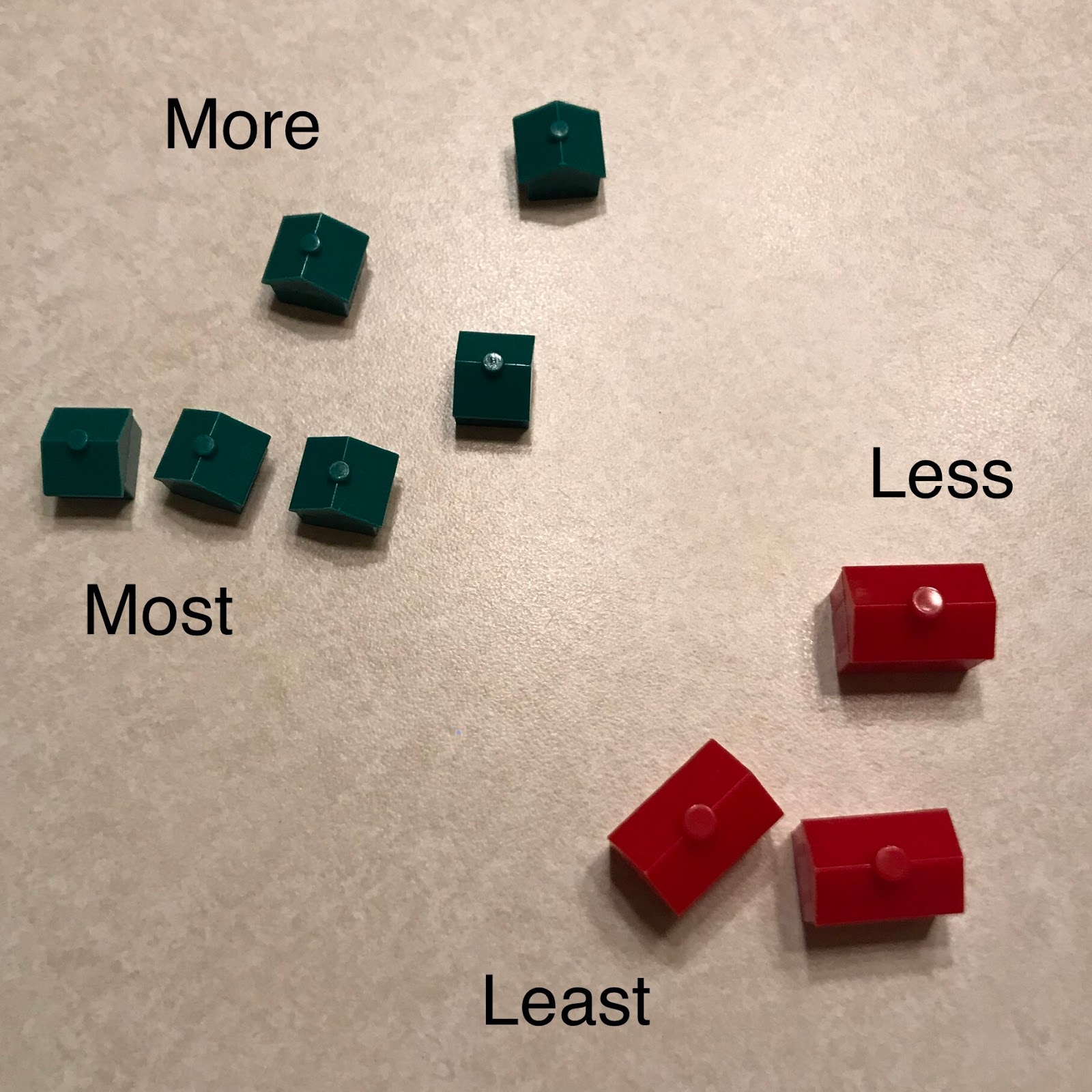
Find an old Monopoly game, or another game with multiple pieces, to use them as your own "math manipulatives." Grabbing amounts of green houses and red hotels, sorting them and finding the totals, will help your child with those skills. Then, add in the math language of "most" and "least" to bring those concepts home :) You might have other toys or games around that can be repurposed for these lessons. Any time you can engage your child in moving, finding, collecting - this will help them learn.

In our house, buttons were always a fun manipulative, as were popsicle sticks. As a teacher and crafter, popsicle sticks were easy to store, and fun to explore with. In our Kindergarten classroom, we used them to count the days of the year, making "bundles" when we reached a group of ten.

Trying this at home may solidify the concepts of higher numbers for tactile learners ... 5 "bundles" (or tens) and 2 "extra" or "all by themselves" (or ones) would be 52. To compare higher numbers to find out "most" and "least," making bundles and extras and touch each one as you count. Your child may understand these bigger numbers better when they can see quantities with their eyes and touch them with their fingers.

By playing with the numbers using games and game pieces, and writing down/matching with corresponding numerals, math becomes more concrete!

And, more fun!


Sunday, July 22, 2018

Photo Magnets: Graphs and Surveys

Have some fun with photos! You can do this in a classroom, or use with family members at home!

Take a great photo of each child's (or family member's) face and attach it to a magnet. I find that the business card adhesive magnets are a great size for this, as well as for many other jobs :)

You can laminate the photos for longer life, or copy them onto sturdy paper stock.

Then, have your kiddos generate some questions that they would like to take a poll on ...

Do you like apples? Yes or No questions work great for simple surveys

OR

Decide on some categories for graphing. What color apples do you like? Red/Green/Pink/Yellow

They will LOVE coming up with categories and questions ... the possibilities are endless!

What's your favorite ice cream? Sport? Book? Use your imaginations!

I like to use "Getting to Know You" questions for the beginning of the school year:

How many people are in your family?
Do you have any pets?
How many kids in your family? Brothers? Sisters?

This gets our new friends talking and sharing, and we get to learn more about them. We use the photo magnets to build graphs, starting at the bottom or left side of a magnet easel or board, and building up or over. As each child answers the question, they come up and place their magnet in the appropriate place on the graph. We can count, and label each "tower" (or line) with numbers when complete.

These magnets can teach sorting, ordering, counting ... you can even work patterns in - boy/girl, ages, etc.! As each child takes their turn, there is discussion and interest, and children making connections with each other, bringing cohesiveness to the group. The magnets are reusable and great for so many other activities, too - dividing into groups, taking turns, etc.

Have fun with them!


Tuesday, March 14, 2017

Board Game Bonanza

Playing board games with your little ones can be so much fun - and such an unexpected learning tool! Along with things you might think of - counting, letters, colors, etc. - game-playing is also GREAT for practicing social skills and language skills!!

To plan some game time, first you need to pick out some fun, engaging, and visually appealing games to play - little ones love to see lots of pictures and colors. When it is set up right, they can "read" what is going on, even before they can actually read words :)

Some first favorites are Candyland and Chutes and Ladders, both of which are labeled for children as young as three years old. They involve moving along a path on a game board, with some counting, one-to-one correspondence, and unexpected turns here and there. Your child will get practice following directions, taking turns, and being a "good sport"- all great things for them to learn!

   
Another fun option is Zingo, a Bingo-type game, where they have to use visual discrimination to cover their cards, to match the pictures/words shown. They get to fill up their whole card and will have a great time doing so :) There are other versions of this game which highlight numbers, sight words, etc., but the first one is all about pictures.

Any one of the Memory games offered at stores or online will help your child with this same skill, as well as recall and position words. With so many Memory games out there, your child will have no trouble finding a favorite to pick from :) They turn over two cards at a time, looking for matches, and then have to remember where the matches are as the game progresses.

Charades for Kids can be so much fun for children - and get them talking and acting things out! These are great ways to grow your child's language skills, both when it's their turn and when guessing what others are trying to show. All the cards have both pictures and words to choose from, so even non-readers can play!

There are Spot It cards for many different skills - alphabet letters, shapes, numbers - and they all help with visual discrimination and language skills - make sure you're talking with your child while playing! Any opportunity to engage in new vocabulary with your children is GREAT!

I recently saw a card game called Dr. Seuss "I Can Do That!" that looks like kids would have a blast playing! Each card has a different, sometimes very silly, activity to do that will get your children up and moving! It's on my list!

Get some games together, and get going! It will be great time for conversation, socializing, learning, and, most of all ....

Having fun!


Thursday, March 3, 2016

Word Problems and Graphing with Goldfish!

Learning math through playful word problems can be super fun - with the right props! Use whatever you want for counting ... reading books about fish inspired us to use pretzel goldfish ... which happened to be in the kitchen cabinet!

To get started, grab a pair of dice, some paper fishbowls, and some yummy goldfish and get ready to play! It doesn't matter which flavor you use - player's choice :)


Players take turns rolling a die and counting out the number of fish into their own bowls. Then, they each take a second turn as you state the problem - "Tommy has 4 fish and he gets 3 more. How many does he have all together now?" This use of typical word problem language, while your child can directly visualize the scene, eases your child into making those connections.

When you have played a few rounds this way and the kiddos are understanding, take it to a new level .... make some fish vanish! Roll again, but this time, it is to take away or subtract! "Sarah had 5 fish, but she ate 2 - how many are left?" Players can keep rolling until all their fish are gone :) Decide on your rules beforehand - ending on an exact roll was one of ours!

If you have rainbow goldfish, you can also practice some math skills by setting up some columns and sorting out the four different colors - then graphing them and using "most" and '" fewest" to describe the amounts. Proper math terms are good to know :)

All of these math skills are goals for any early childhood curriculum - but always, always make it fun - yum!


Tuesday, February 23, 2016

Playdough for the Win!

There are SO many things you can use playdough for - make all of them super fun!!

Small Motor Play
  • Roll it out and cut out shapes with cookie cutters
  • Pinch and pull to strengthen muscles
  • Cut thin ropes with scissors for resistance
Literacy Practice
  • Roll out "snakes" to make letters, numbers and shapes
  • Get letter or number stampers and make impressions in the play dough
  • Use as base for thematic play with sticks, blocks, yarn to recreate a story 
Science
  • Mix up some playdough with your kiddos - make predictions, measure, add, see the ingredients come together
  • Take shells or other natural materials and make imprints like fossils
  • Use small figures of animals, dinosaurs, etc. to make tracks


Sensory Play 
  • Add dry jello to scent it 
  • Add salt to make it gritty
  • Add glitter to make it sparkly
  • Add all to make it super fun!
  • Introduce beads, buttons, or fake jewels to up the interest factor

Math
  • Take a muffin tin, add tape with different numerals written on it to each cup and roll small balls to make the amount in each cup.
  • Make playdough pancakes and serve them up on different plates to give equal portions - one for you, one for me, etc.

Ask your little ones what THEY would like to do with the playdough - they will come up with even more ideas :)

Have fun!!


Sunday, August 16, 2015

Water Painting Fun!

The last days of summer are coming fast ... running out of things to do with your little ones?

If you have some water in a bucket and an old (or new!) paintbrush - find a surface like a sidewalk, driveway, or concrete steps, and see what happens. Fun for the pool, too!

They may want to paint the whole surface. They may begin to make shapes or squiggles ... all great for motor planning and control!

You can model a little, if you want ... in a parallel playing sort of way :) Draw a letter - maybe the first letter of their names. Something about wet letters gets their attention. Use different sizes of paintbrushes for different effects.

You can also make chalk shapes, letters, numbers .. and, then paint over them. Any "mistakes" quickly evaporate and then, they can do it again! This would be great practice for back-to-school - getting familiar with names, shapes, numbers, etc. - in a very no-fuss, enjoyable way :)

Have fun!

Sunday, January 18, 2015

Numbers, numbers, everywhere!

So, your children are ready to begin counting?! First, you want to start with one-to-one correspondence ... touching each object as you count and associating the oral number with a bunch of objects. As you are counting blocks, touch and say, "one, two, three - I have three blocks!" You should see your child copy this behavior, after some modeling. Then, play games to see who has how many - I have three cars, how many do you have?

After children understand that groups of objects can be assigned a word (numbers), show them what numbers look like! Show numbers in text and play a find the number game. There are many counting books available, with fantastic illustrations, to help generate interest! Whatever your child is interested in, there is probably a book that shows counting and numbers related to it! Eric Carle's wordless book, "1, 2, 3, To the Zoo!" is a favorite to start with. Look for Dinosaur counting books, books with fairies, etc., ... there is something for everyone! "Over in the Meadow" and the "Five Little Monkeys" books are favorites for rhyming songs with numbers. 


When your child is ready, look for numbers in other printed material, such as newspaper flyers and mailers, and make separate collages of each number - work on one number at a time. Use Legos to "build" the number and talk about how it is formed. Play some silly finger plays like "Five Little Monkeys Swinging in a Tree" to reinforce the number names, too!


When you're ready for hands-on number making practice, use the different letter forming fun tricks mentioned in former posts! You can also find heavy-duty plastic paper protector sheets for 8 1/2 by 11 paper and make some templates to slip in. Then, practice with dry erase markers to your heart's content :) Some children like to practice using a Rainbow Write technique, which is to form the number with a pencil very nicely, and then go over it for repetition with many colored pencils. 


Take it step-by-step and only introduce the next step when your child is ready. Frustration is the last thing you want your child feeling! Have fun!