Showing posts with label authors. Show all posts

Monday, October 5, 2020

Social Emotional Learning with Karma Wilson’s Bear books

SEL (Social-Emotional Learning) is a big topic these days, with all that is going on in our world. Anxieties are at an all-time high, even with the little ones. Opening up discussions about feelings can get an assist from reading an applicable story. Extend Social-Emotional Learning through thoughtful literature choices, giving children a way to identify feelings and relate them to happenings in their own lives.  

Help kiddos deal with BIG feelings that they might have - read Karma Wilson's Bear books with them. These stories are beautifully simple, and the illustrations, by Jane Chapman, are SO appealing to the kiddos, and draw them right in.   

These Bear books shine a light on one topic at a time, using the familiar Bear and friends characters, and tackle things like making a new friend, not feeling good, feeling scared, and other relatable issues.


When Bear expresses his feelings, pause and invite your students to share their own feelings ... “Does anything make you scared? What do you think is scary? What do you do when you’re scared? What COULD you do?” Opening up these topics lays the groundwork for future discussions or interventions, by establishing common reference points that you can refer back to when those big feelings emerge at a later time, in your class or at home. 

Act out some scenes with your kiddos to really solidify the learning - have them make faces that reflect feelings. Play a guessing game where friends guess how a friend is feeling by their facial expressions. Use emoji cards (super easy to make!) to give ideas :) 

Have fun while exploring feelings!


Tuesday, September 22, 2020

Book Choice: Expanding Equity

There are so many great, diverse books for children that can be introduced into your home or classroom library, enhancing your selection, making it more multi-cultural and more equitable. By showing characters of all races, creeds, and family and home situations, you are including all in your home or classroom, and making sure that your children are seeing that the world is full of wonderful diversity. Showing characters with physical challenges, or including characters who might have unseen differences, opens up great conversations and normalizes varied situations.

A short list of favorites doesn't even begin to touch on some fabulous new and old titles. Use this as a jumping off point, but keep adding to your own list - it's so important! 


Some books to look for ....
 

The Day You Begin by Jacqueline Woodson (2018)

This book doesn’t leave you at how people are different but rather reminds us that when we reach out and take the first steps, people meet us half way.


This Is How We Do It by Matt Lamothe (2017)  

One day in the lives of seven kids from Iran, Russia, Peru, India, Japan, Uganda, and Italy. Highlights differences and sameness about their schools, homes, dress, food, play, etc.


La Princesa and the Pea by Susan Middleton Elya (2017) 

This is a great retelling of the familiar fairy tale, with up to date illustrations by Juana Martinez-Neal. Check out the glossary of Spanish terms up front before reading.  So great for native Spanish speakers to celebrate their native tongue. Look for other books of this type - familiar stories with different languages and cultures featured.


Jabari Jumps by Gaia Cornwall (2017)  

This beautiful, simple book is very relatable for all children – the main character is working up courage to jump off the diving board.  Looking for books that show characters of all colors helps students see themselves in books.


The Bad Seed by Jory John (2017)  

The cool, graphic illustrations show the Bad Seed (the "bad" kid) and how it got to be bad … you will start to feel sorry for the bad one and root for it to go good.  Shows a kid version of trauma, and trying to find good in what can sometimes be a tough world … the right book for a certain situation.  Great for helping students develop empathy.  


The Diwali Gift  by Shweta Chopra and Shuchi Mehta (2015) 

The characters get a gift from one’s grandmother, Dadima, to celebrate the Hindu Festival of Lights, Diwali. Explains some traditions of a Diwali celebration – may help some students make connections to their holiday, which may not be a holiday all know about. Definitely read the glossary in the back for definitions first. 


All Are Welcome by Alexandra Penfold and Suzanne Kaufman (2018)  

This story is told in its pictures and has to be looked at closer than just the words on the page. Pictures depict children of all races, religions, etc. working and playing together in a school environment. 


Whoever You Are by Mem Fox (1997) 

This is a sweet, classic book which celebrates the similarities among people, instead of differences. 


The Sneetches by Dr. Seuss (1961) 

This book has an important message for any/all marginalized groups. 


The Family Book by Todd Parr (2003)  

All kinds of family groups are shown in this inclusive book. This books shows us that no matter what size or shape your family is, it is a great family for you. 


The Paperbag Princess by Robert Munsch (1992)  

The Princess saves the prince and then figures out she’s better alone - flips the gender stereotype.


Do this important work to celebrate diversity! 


And, as always, have fun doing it!

Friday, September 4, 2020

Exploring with Ezra Jack Keats

Ezra Jack Keats was a groundbreaking author/illustrator who left us a gorgeous collection of storybooks, with characters drawn from minority groups and what he called "outsiders.” When The Snowy Day (one of the first books that Keats authored) was published back in 1962, it broke the color barrier for depictions of characters in children's books. 

Keats had grown up poor during the Great Depression in a Jewish neighborhood of New York City, and said he knew what it felt like to feel "outside the group." Although he was white, he decided early on to make many of his characters reflect the varied groups of people that he saw every day, who were not seen in the books he read. His use of urban settings and characters representing all races, set him apart as an author and illustrator and won him awards, such as the Caldecott Medal, for his work.

As a teacher, I can recall reading The Snowy Day to a class, including children of color, and having children get excited about seeing "themselves" in the story book. It was a wake-up call for me to curate my classroom collection so that this wasn't an unusual occurrence, but rather one of many books depicting characters from all races, creeds, living and family situations, etc. As Ezra Jack Keats believed, "all children should be able to see themselves in a book they love."


Keats went on to write and illustrate many, many books. Some of his characters were featured in several books, such as Peter, first seen in The Snowy Day. Peter was featured in 5 or 6 books, and grew up to be an older child in Pet Show. Students get very excited when they make this connection!


Keats' style of illustration was also so engaging and is completely captivating all these years later! He used all different methods, incorporating some collage, gouache, pen and ink, etc. in order to keep his art interesting. Kids find his colorful work fun to look at!


There are so many Keats stories that you can build an extension activity from ... 

The Snowy Day - use a shaving cream/glue solution to layer on “snow“ and use urban building silhouettes to complete a landscape and then write about it.

Peter's Chair - remember a "special something" that was handed down in your family and draw it, cut it out and embed it in a picture with more collage elements.

Whistle for Willie - imagine hiding in a box or learning a new skill and who you would surprise with it ... now draw it or write about it!

You can use any book to try collage, embedding some newspaper scraps and even fabric in a picture and writing about a character or scene from the story.

For more information about Ezra Jack Keats, click below:

https://www.ezra-jack-keats.org/

Have fun!


Tuesday, August 7, 2018

Books to Love: Commotion in the Ocean

A book like "Commotion in the Ocean" by Giles Andreae, can be used to teach so many things, besides being so FUN to read! The illustrations, by David Wojtowycz, catch your eye with their bright colors and cartoony features, which sets the stage for the silliness to begin :)

Each short poem about different sea creatures introduces new names and other related vocabulary, broadening the scope of what your child may know about each of these underwater animals.

The rhyme and rhythm incorporated in each poem will draw your child in - play the waiting game at the end of each section, drawing out the last sentence to see if your child will complete it with the final rhyming word :) Rhyming is an early reading indicator, and is best taught through organic word play within a text :)

Your child may want to recall and list the sea creatures, practicing sequencing and ordering. Or, maybe they would prefer to retell facts about each, displaying some retention or comprehension of the content. You could even simply play with beginning (or ending) sounds, stretching out the name of the animals.

Kiddos always love to hear sound noises and you can show them how they are shown as onomatopoeia, within the illustrations ... snippety snap and click and pitter patter. Try to re-create them using hands or toys or sticks - so much fun!

As an extension, the illustrations in this book provide great, simple shapes for tracing on paper and making stick puppets of each creature. Your child will get practice with tracing, cutting, and other fine motor practice while creating something fun - and useful! Attach craft sticks to make puppets or make sets for practicing visual discrimination and matching games, all centered around the sea creatures in the book!

So many things you can do!

Have fun!


Tuesday, February 28, 2017

Dr. Seuss Books to Learn With

It's hard to choose a favorite Dr. Seuss book! There are so many and they each have a different lesson to teach ... and, they're so fun to read!

"Hop on Pop" is a great first read-along for your little ones - there are lots of Consonant-Vowel-Consonant (CVC) words involved, and many are rhyming words, which makes them easier to figure out. That feeling of success when kiddos first realize that they recognize a group of letters can propel them into being lifelong readers :)

Play a little game with some letter tiles or index cards ... look for a word that you can work with to change out a letter and make a new word. Show the word first in the book, and then build it with your props - sound out each letter and then ... SWITCH! Change out the first letter, like HOP and POP and watch your child get excited about what they could do with this!

There is nothing better than a little one bringing you a book, with THAT SMILE on their face, and saying "I can READ this!" I see that smile most often with a Dr. Seuss book attached!

"Green Eggs and Ham" is another early favorite! It's silliness and rhymes again make it easier and more fun to read - and the repetitive, lengthening list is a challenge that is still fun for them! The use of positional words is embedded in the text, and can give your student a boost in this math skill.

Pull out a favorite toy or stuffed animal and play a positional word SIMON SAYS game: Simon Says put the Teddy under the chair ... Simon Says put the Teddy in the cabinet, etc.

"Ten Apples Up On Top" is a favorite of many, and can really be enjoyed as a loud, dramatic read aloud, when it gets more and more exciting, as the numbers rise! Counting is of course a focus here, but not the only thing happening. You can discuss feelings and facial expressions, to look for social clues in the illustrations. There are different arrays of apples, up and down and stacked in groups ... not as easy as counting in a straight line!

Look for lessons all around while you are enjoying your Dr. Seuss books ... or any books!

Have fun!

Sunday, February 26, 2017

Learning with Lois Ehlert

When you start to plan some garden activities, make sure that you gather up Lois Ehlert books to help your little ones understand what the garden is for! The illustrations and vivid colors are so attractive, and the messages are clear.

Start with "Planting a Rainbow" to illustrate the planning and planting process. Colors are the highlight here, as the flowers in the flower garden all represent the colors of the rainbow. The process of growing from seeds and bulbs is also shown.

"Growing Vegetable Soup" is a great book to show the growth of vegetables from start to finish. Little ones are not always sure where their food is coming from, and may need the visuals to make connections between what they eat and how it come to be. Combine this with a trip to a local farm or farmer's market to get your child's brain thinking outside the supermarket.


"Eating the Alphabet" is another great book for seeing what different foods people eat, including some your child may not be familiar with. It relates each food to alphabet letters, both upper and lower-case, for authentic learning. When children can see and experience things that they read, it becomes more real and stays with them longer. Learning the alphabet this way will give them reference points - visuals - to connect to.


Lois Ehlert is the author of so many great learning books - "Color Zoo" teaches shapes and animal names, as well as giving children a view into how pictures can be broken down into shapes, for easier drawing :) Die-cut pages and surprise flipsides give every reader something to look forward to, as the pages turn.

In the fall, "Leaf Man" and "Red Leaf, Yellow Leaf" are wonderful tools for learning all about the changing of the leaves and the process that deciduous trees go through each cycle. The author' s creative use of natural materials to make pictures in "Leaf Man" will have you and your child seeing leaves in a whole new way! Try to make your own leaf creations when you're done :)

"Snowballs" is a crowd favorite for wintertime - something for every season! The use of natural, found items in her pictures is one of her style choices that delight young readers, as they find things on the page that are familiar.

Lois collaborated with other authors as well, illustrating the "Chicka Chicka" books, among others, so it's easy to see why her style is so familiar and attractive to little ones - and everyone!

Have fun reading!

Saturday, February 20, 2016

Sharing and Caring

Extend Valentine's Day by talking about friendship, with explicit lessons about making and keeping friends, taught with storybooks. Sometimes our little friends need things spelled out for them ... and what better way than through a story?

Rainbow Fish, by Marcus Pfister, tells the story of a little fish who is beautiful to look at and sought after to play with, but when he snubs the other fish, they stop trying to be friends and he feels isolated. Through learning to share, the Rainbow Fish eventually makes friends, and plays happily with his new friends. (I always stress to my little ones that sharing friendship and experiences is really the best gift of all. )

Corduroy, by Don Freeman, is told from the viewpoint of a stuffed bear who just wants to belong to someone and have a home. This sweet book can be a stepping stone to great conversations about inclusion and making sure no one feels left out - and how good it feels to feel wanted!!

My kiddos always enjoy The Crayon Box That Talked, by Shane deRolf. It gives voice to all the different crayons, who eventually put aside their griping to see that if they all work together, the results can be amazing - a great lesson for those having trouble sharing and working as a team.

Of course, there are always some great on-their-level Clifford books to go with these friendship lessons. Clifford's Pals and Clifford's Best Friend, by Norman Bridwell, highlight friend relationships with characters that are known and loved!

Take some time to read through these titles and others before reading with your kiddos, so you know what discussion points you might want to steer them towards. Or ... let them do the talking and encourage them to share what they feel like after reading these books - and any connections they might have to the characters in the stories. Sit back and listen while you color a picture together of one of the characters - great coloring sheets and extension projects are available on the author's websites.

http://www.marcuspfister.ch

http://www.penguin.com/static/pages/youngreaders/children/features/corduroy.php

http://www.scholastic.com/clifford/books.htm

Or, search Pinterest - great ideas should pop up!


Have fun!

Saturday, January 23, 2016

Snow day!!


It is snowing here today - the kind of snow we don't get too often :) If your little ones have had enough of the cold, but not quite enough of the snow ..... OR, if they (or you) aren't up for getting out there ... BRING IT IN!!


Take a big container and fill it with snow, then find a place where it would be great to dig in and play with it. An old shower curtain liner or a vinyl table cloth would make a nice floor mat, or just put it on the countertop and know that it will be easy cleanup - it's just water!!


   Then, play! We got out some little cups and containers and dug around in it ... if your little ones' fingers get cold, put the mittens on inside :) Build a tiny snowman and decorate it with anything you can find in the kitchen - check ours out!


For a science and math connection, fill up a measuring cup with some fresh snow and wait it out - check back every half hour to see what happens.

Make some predictions and take some measurements - you will be able to see how much the snow shrinks and what the water amount is for the snow you collected.

Grab an erasable marker to make some marks showing the progression :)


There are so many literacy connections for Snow - look for books like "The Snowy Day" by Ezra Jack Keats on YouTube if you don't have any titles in your snow-bound home! Enjoy!!


(This post is inspired by a picture I saw from my friend Mary Ann, but I just loved it and wanted to share the idea :)


Sunday, November 1, 2015

Fun with "Leaf Man" by Lois Ehlert

When the leaves start to change colors and fall from the trees, it's time to have fun with leaf projects!!

First, find the book "Leaf Man" by Lois Ehlert - it is so much fun to read ... and your children will love the awesome illustrations! Each one shows a different character made entirely of leaves ... animals, people ... make sure you look carefully to see it.

Next, take your little guys on a leaf hunt to find as many different varieties of leaves as you can. Make sure to get a variety of colors and shapes, and sizes, to make your own illustrations really cool!

Then, set out your leaves on some contrasting construction paper and move them around, making different combinations until you make a shape that looks interesting :)

Have your little ones try different combinations to make different creatures, and finally, get ready to glue them on paper or encase them in plastic, to keep them forever. You can use glue dots to fix the leaves where you want them, or you can use clear contact paper to make them into a "sun catcher." Either way, make sure you add details, like faces, eyes, hands, paws ... whatever will make your character come to life!

Have fun!

Saturday, October 24, 2015

Books to Love: "The Quilt Story" by: Tony Johnston and Tomie dePaola

There are all kinds of stories - silly, funny, scary, sad ... real stories, pretend stories .... even stories that help your children see something new about the world they live in. Realistic fiction has a important place in your child's library, and can help them learn about things that happened before they were born.

The Quilt Story gives a little history lesson and opens up all kinds of discussions about the past - the past of your country, your family's history, even your own past - before kiddos. It tells the story, in words and pictures, of a quilt which has a place in a family's history and then is rediscovered by a later generation. 


The illustrations also help to tell the story, so make sure to integrate them into your reading :) Look for changes in buildings, dress, transportation, etc. After you read, you can go through your own old family photos, looking for changes that tell the story of your family, too. 

You can extend the reading of this story with so many art projects - use stencils and paper cutouts to design your own quilt or even piece together fabric scraps on paper, using glue instead of thread. If you are really handy, you can show your child a simple stitching pattern with a child-friendly needle and thread :)

The Quilt Story is a special book, with fine illustrations by Tomie dePaola, and makes a great cuddle-up read for bedtime. Watch out, though, your kiddos just might have to search out a forgotten blanket when you're done ....

Have fun!

Saturday, September 12, 2015

Books to Love: "Bear Snores On" by Karma Wilson, illustrations by Jane Chapman

Kids LOVE the Karma Wilson Bear books ... This was the first one I discovered and it was an instant hit with my little ones! (There are more!!)

This terrific read-aloud will get your kiddos involved in the story right away with the use of engaging illustrations, by Jane Chapman, and the rhythm of repeating lines. Right from the start, the story builds ... As each new animal joins the story, seeking shelter in the cave, the words get more interesting and the print sizes up and down, from whisper-tiny to shout-out-big! As each new element is added to the sleepy scene, the same phrase caps it off - but it will get louder and louder, as your little friends join in!

Use this book to teach sequencing and pause to recall what happened first, next, and last. Use it to teach concepts of print and have your kiddos point out the words, left to right, one by one. Ask about the characters and make a list of all the animal friends. Try a child-led retelling, for comprehension assessment, using all the sweet pictures. Talk about friends sharing what they have, and meeting new friends. 

Most of all ...
Have fun!

Sunday, July 26, 2015

Books to Love: "Wet Dog!" by Elise Broach, illustrations by David Catrow

Every time I pull this book out to read, my kiddos go nuts over the pictures, even before I can say the title. Everything about this book makes you smile. David Catrow's fluid, detailed illustrations draw in the reader, and the use of rhyme and rhythm in Elise Broach's storytelling makes them want to join in ... and, they do!!


There are repeating lines that become group chants and the excitement grows as the story unfolds and your little ones start to anticipate what will happen next. Predicting and sequencing the appearance of each story element will add to the fun - and is a great comprehension tool!

This is a great read for the hot, summer days - you can almost feel the droplets of water as the wet dog shakey-shakes off :) After reading, go back and find all the delicious, descriptive ways that show how hot the main character is ... There are so many, you will lose track.

Make sure you spend some time poring over each new setting, as it is introduced. The details are amazing! There will be some recall at the end, as you and your little ones put the pieces together for the culminating scene. This fun book will quickly become a new favorite. :)

Have fun!


Tuesday, July 22, 2014

Reading Treat: Very Hungry Caterpillar Fruit Salad

Celebrate Eric Carle's birthday this week (July 25, 1929) by making a beautiful fruit salad with your little ones!

The Very Hungry Caterpillar, by Eric Carle, is a favorite of children all over! This adorable book has the recipe right in it's pages, so sit down and read it again with your child to get started. Make sure you have a paper and writing tools ready, so you can help your child spell each ingredient ... getting some letter and number practice in while you do! (Only the first five fruits should be added - after that, you might get a bellyache like the caterpillar!)


When you have your list, check off what you have in the kitchen and then make a trip to the produce/grocery store. Your child will want to help find the ingredients, weigh them, and purchase - great lessons all the way around!

Make sure to wash all the fruits before using and cut up (with supervision or adult intervention) into small chunks. Add a little citrus, orange or lemon, to keep it fresh.

Now, enjoy your Very Hungry Caterpillar Fruit Salad as a treat or as part of your meal!

Have fun!


Sunday, October 27, 2013

Making Friends: Books to Read

Such a big part of the early years is moving beyond the world of self into the world of friends. Just as we learn many other concepts, our young ones need "friend behavior" modeled and practiced to get started.

Make time for interaction with other children - get out, go for walks, stop and check out areas where your children might spend some unstructured time with others. It doesn't have to be a special dance or sport or art class - although these can be great fun, too! The important thing is that your child gets a chance to mingle and learn what is expected behavior with friends and what isn't! Practice makes …
well, maybe not perfect, but better :)

As another strategy, read to your child from consciously selected books about friendship. There are so many wonderful books that allow children to see characters whose feelings mirror their own, giving them voice. For little ones, the Rainbow Fish books by Marcus Pfister are great, as are the Bear books by Karma Wilson. They have simple language and engaging illustrations, just right for teaching things like sharing, making friends and caring for our friends.

For older children, Chrysanthemum by Kevin Henkes is a personal favorite. Children can see what bullying behavior looks like and sounds like, and will vow never to be like that! Chester's Way, another Henkes story, is also fantastic for friendship themes like taking turns and having more than one friend.

For a list of books on making friends, click on:

https://www.themeasuredmom.com/books-about-friendship/

Reading about these themes opens the door for discussion - never let an opportunity get away to help your child develop these much needed social skills.

Above all, have fun with it!

Wednesday, October 16, 2013

Great Halloween Reads!

Halloween is a fun time - and a fun time to read some GREAT stories!!

Two of my favorites to look for:

Too Many Pumpkins!
by: Linda White / Megan Lloyd

This story teaches on so many levels! Work on sequencing with the story of pumpkins growing, from splattered pumpkins to sprouts to vines, etc. Show how it becomes a circular story, with the seeds at the end of the book. The pumpkins' growth, despite not being wanted or cared for, is displayed through the book's interesting artwork and wonderful words.

There is also the deeper story of the book's main character moving from an isolated, unhappy life to having an entire group of neighbors who join her for Halloween festivities. "Too Many Pumpkins" is a consistent favorite with little ones up through primary grades.

Pumpkin Jack
by: Will Hubbell

Kids love this book! Any child who has had to throw out their pumpkin after Halloween will appreciate the way Tim disposes of his pumpkin - in the garden. It has great lessons about the after cycle of the pumpkin's life ... From a Jack-o-lantern to a mushy mess to a snow-covered mound. Then, in the Spring, new life brings Jack (and many others!) back to the garden! Great illustrations and  descriptive metaphors that kids can understand make this a book to treasure.

Have fun reading!!

Sunday, May 19, 2013

We Are Scientists: "Discover" Symmetry

Have some fun with symmetry in nature ... It's perfect for Spring!

First, find some beautiful non-fiction books that show full-winged pictures of a variety of butterflies and bugs. Have your children inspect some close-up pictures to "discover" all on their own ... lessons stick better that way! Direct their attention to specifics in the photos and have them do the "noticing."

There are also many children's book authors who use beautiful artwork displaying symmetry in fiction stories depicting animals or insects. The books might tell about the seasons, life cycles, or natural occurances such as camouflage - you might have some on hand that are already favorites of your children. Eric Carle's book, "The Grouchy Ladybug," shows symmetry in the collage work he does, even though it has other themes. Use resources you have on hand to draw attention to something new!

Then, get out there and explore! Make sure you have a "kit" to inspire your little ones to get into the activity. Our kit consisted of some plastic tweezers, magnifying glasses of different sizes, some index cards (for lifting delicate specimens), and a small container with holes to temporarily house what we found. It all fit in an old lunch box ... a small sand bucket would do nicely, too! Your child will be delighted to find all sorts of examples in the critters you uncover! Make sure they are using their words to describe what they see - and you could even bring along a sketch book and some crayons to do critter portraits :)

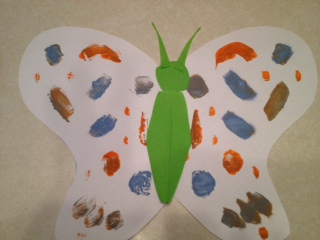
For some fun artwork, when you're back from your travels, fold a large sheet of construction or other heavy paper in half. Draw the shape of a butterfly's wing (or another bug's) on one half with the center of the body at the fold. Cut through both pieces of paper so when you unfold, you have a butterfly shape. Have your child make a design on only one of the wings with some acrylic paint and then fold and press gently to transfer the design to the other wing. You should end up with a mirror image - symmetry!


You can finish up by adding a body, head and antennae with some paper scraps, pompoms, or whatever you have on hand!

Have fun!

Tuesday, April 2, 2013

Mix Up Some Colors!

Make learning about colors fun!

Learning about primary colors - blue, red and yellow - and the colors they make when blended together - is so much fun for little ones! Get some washable paints and some large paper and get ready to mix and make!

There are some wonderful books that illustrate for children just how to do some color mixing! Mouse Paint, by Ellen Stoll Walsh, is an adorable tale about white mice who jump into different paint colors and end up mixing them up on paper, thereby creating new colors through blending. Your child will love the cute little mice and the patterns they make - it is a perfect way to explain how blending certain colors results in new colors.


Let your little "mice" replicate the story by mixing up some paint colors of their own. Playing with paint and paper is fun, messy and will have your little ones exploring - and learning! You can use fingers, brushes, sponges or even fabric scraps as your tools ... try each primary color first and then see what happens when a dot of something else enters the picture! Let your child direct the learning and be ready for some terrific artwork! Have extra paper on hand for when "experiments" turn everything brown or gray and your child wants to try again :)

Another book on the same theme is Color Dance by Ann Jonas. Children will be fascinated by the swirls and twirls of the colored scarves in this lovely picture book! Make sure to linger over each illustration and have your child retell the story to you to reinforce the learning. Explore some fun with movement by trying out some scarves of your own ... then, look for colorful fabric scraps or bits of ribbon to make a color collage!

Have fun!

Wednesday, November 7, 2012

Books to Love: "The Great Gracie Chase" by Cynthia Rylant

"The Great Gracie Chase: Stop That Dog!" written by Cynthia Rylant and illustrated by Mark Teague is a wonderful book for kids of all ages. Your little ones will fall in love with Gracie, an adorable, good dog who loves living in her quiet house. Then, her life gets disrupted by some painters and Gracie decides to leave, beginning a chain reaction of people who follow her to get her back home.

Well-written books can be so much fun to read - sometimes, again and again! Action-packed books like "The Great Gracie Chase," filled with great images and descriptive language, make it so easy for children to visualize the characters and action taking place.


Kids will love the bright pictures and funny portraits of the various characters who join in the chase. Try some of these activities:

  • After reading, try to recall the order of the appearance of the various characters and record them in a list - see how many you can get before checking back in the book.

  • Talk about the parts of the story - the beginning, the middle, the end - and about how the chase keeps building, adding people and then narrowing down to the end, like a cycle.

  • Children can draw their favorite parts for retelling. Introduce transition words like first, next, then and finally, to help them put their stories in order.

  • Trace a black and white picture of Gracie for little ones to color and make into a Gracie puppet, attaching a craft stick for a handle. 

Have fun with it!

Thursday, October 18, 2012

Books to Love: "The Dot"

The first time I read "The Dot," by Peter Reynolds, it felt magical ... and I was reading it by myself in the bookstore.

The first time I read it aloud in a classroom, the magic was apparent - every child was listening raptly with such intent expressions! I LOVE this book!


Children will identify with the character and become empowered themselves as the story unfolds ... every child has a little bit of the main character, Vashti, inside. Anyone who has ever hesitated to put themselves out there, or who thinks "I can't do that!," should get a copy.

When Vashti thinks she can't paint, she is encouraged by a teacher to start with just a dot ... and to sign it. That starts the ball rolling and Vashti's confidence and self-worth grows and grows. The ending is particularly touching.

Every time I read it, a few children chime in at the ending - they just know what it will say. This is a great book to use for a child who has a hard time getting started, someone who's not sure of themselves or their skills.

Extend the book with an art project ... have your child choose a simple shape or object to explore and provide them with open-ended art supplies - see what happens! Maybe you will have a beautiful gallery of squares or triangles ... make sure your artist signs their work!

For more art extension  ideas, check out the author/artist's website: http://www.peterhreynolds.com/dot/dot_activities.html

Have fun!

Tuesday, May 22, 2012

Fun with Birds!

This time of year, all the kiddies are longing to be outdoors. Structure your learning around an activity they can all enjoy: bird watching!!

Put their powers of observation to the test - have them peep through some homemade "binoculars" to get started. Tape two small cardboard rolls together and decorate as you wish: we used packing tape to secure ours and then added some construction paper and stickers. There are some really cool designs out in duct tape now, too! Add some yarn or string to hang them and you're all set!

Here's a cute little art project: cut two circles out of white paper and then a larger figure-eight shape out of black. Attach the two circles as lenses of the binoculars and tell your kids to draw what they see in the "eyes" of their binocular pictures. Have them dictate "I see ..." to finish it off!

Check out some bird websites for some identifying pictures and let your little ones try to paint some birds of their own. Sponges in small and medium ovals or circles for the body and little triangles for beaks will help them make a bird shape - then dip some feathers in semi-dry paint to add details. So cute!

Find a children's guide to bird watching at your library or bookstore and don't forget to read some great fiction books, too! "Are You My Mother?" is always fun to read and "Round Robin" by Jack Kent is another favorite of mine!

While you're checking out the birds, fix up a simple bird feeder for your yard. Take a large pretzel, tie a ribbon on it long enough to hang it from a branch. Then, roll it in a small bit of peanut butter (unless there are allergies to watch for!) and dip it in a pan of bird seed from your local market. All you have to do is tie it to a tree branch and wait for the birds to find it. It will make a great spot for sighting some favorite local birds!

Have fun!