Showing posts with label reading. Show all posts

Sunday, August 4, 2024

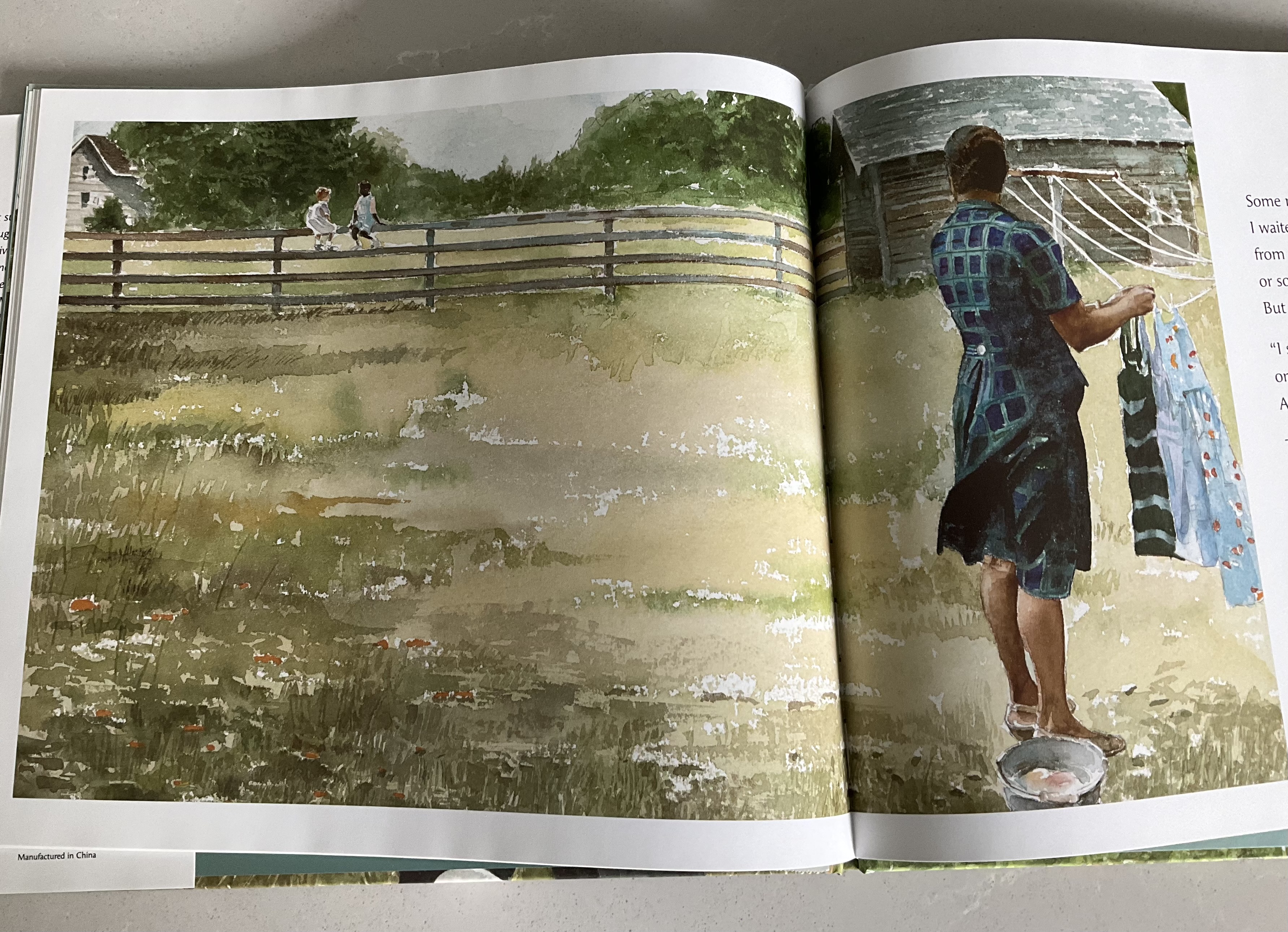
Book Choice: The Other Side by Jacqueline Woodson, illustrated by E.B. Lewis


Once in a while, you come across a book so perfect, so beautiful and important in story and matched wonderfully with its storytelling artwork, that you pick it up again and again, even as an adult. 


Jacqueline Woodson has written several books that my readers and I LOVE, but something about this one makes my kiddos open up a reflective dialogue every time it gets read. It shows curiosity on both sides about a possible friend, but also the real (or artificial) barriers put in place to keep them apart. Yet, it unfolds so gently, it often leads them to wonder, “Why can’t they be friends?” 


Clover and Annie bridge this divide by letting their friendly natures overcome the barriers, and find a way to be together and get to know each other. Once they do, they explore the ways they are similar, rather than the ways they are different, leading to new knowledge and friendship. 

I love the way this plays out, and Woodson’s word choice and descriptions are on point. Children as young as Kindergarten have warmed to this book and its message, and asked important questions during and after this read.


The illustrations add to the perspectives in the book, and, when simply doing a picture walk through this book, you can see the story unfold. The message is deep and the seeds of hope it sows are so important to share with our upcoming generations.

Note: This is not a new book - it was first published 23 years ago. Hope is a living thing - hopefully, it has grown since then and will continue to keep growing ... 

Have fun reading :)

Tuesday, October 5, 2021

The Reading "Game"

When kiddos first begin to notice the printed word all around them, it is a GREAT time to tap into their natural curiosity and begin to name the letters for them to learn. Making it into a game makes it that much more fun and appealing :)

When the kiddos ask about signs or symbols, challenge them to tell YOU what it means. Follow their lead to gauge interest and start with letters that are part of their world - letters they see every day and ask about! "What does that say?"

Point out letters casually - and make the primary sound the letter makes, as well as naming the letters. This connects sounds to letters and sparks more connections and interest. 

Play games with their beginning name letters and then words that are important to them, like Mom or Dad. When the sound/letter has more meaning to them, they will likely be more interested. Interest leads to retaining information, as well.

Call attention to words in your everyday life .... Muffin! That sounds like mom at the beginning ... mom, muffin, .... what else?

******************************************************

Then, over time:

Make a word collector ... Draw boxes on a big sheet of paper or make a notebook. Add drawings or clippings from magazines with pictures of words that start with different beginning sounds.... label them and repeat them in groups, mom, muffin, mop, mountain. 

We had fun making matching cards for beginning sounds, using magazines and index cards - got in a little cutting and gluing practice, too! Car and candy are a match for beginning sounds, so are bed and bathroom! These were easy to find in brochures that came in the mail!

******************************************************

Keep the format loose and don't try to make perfect letters at first - there's time! Make sure when you do, that you are teaching them the right way - make your letters from the top ... pull down from the top to make tall or other letters (b, h, i, j, k, l, m, n, r, p, t, etc.) start with a letter c to make others (c, a, o, d, g, q). Making letters this way helps them later on, when they are learning how to write cursive.


Remember, have fun!


Saturday, November 14, 2020

Explore your world: Me On The Map

The book Me On The Map has so many great lessons within its pages. First, it’s a beginner book about maps and geography. As you turn each page, the world gets a little bigger, moving from a room in a house through a town, state, country ... all the way to a spot on the Earth! Then, it solidifies those concepts by tracing them backwards, through beautifully drawn maps, coming back to the room where it starts.

 It is a perfect book for showing students how big the world is, and where they fit in on our planet Earth. It also shows cool, simple maps, opposite pictures of the places that are being mapped. Each time I read it, I see something new in the pictures and maps. (You can find read-aloud versions on YouTube, if getting to a library or bookstore isn’t an option right now.) 

As an extension, try mapping your classroom or playground area. Talk about symbols and shapes that represent objects. Kiddos love to draw and read maps, and would be delighted to try to make a map of their own room or house!

Written by Joan Sweeney and illustrated by Annette Cable, this Me book was followed by Me and My Place in Space and Me and My Family Tree, each with their own ways of helping children see where they come from or fit in - in the bigger world. Learning about the planets in our solar system and how families are made up are the bonus lessons here!


When you’ve read these, check out other Me books by Joan Sweeney and Annette Cable - they each teach something new :) 

Have fun!


Wednesday, October 14, 2020

Learning and Blending Sounds with Movement

When learning sounds or how to blend sounds to read, adding movement activities can help for increasing focus and solidifying the learning. 

There are lots of programs with motions that connect letters to sounds - if you have access to one or can find one on YouTube, it’s a great way to help your child(ren) make connections between sounds and letters. If not, consider making up one of your own!

As a next step, blending across your fingers (touch each one as you make a sound) or up/down your arm (chop each sound at a different point on your arm) are great ways to start with helping beginners understand the art of blending sounds together to make words.

Sometimes it helps to add objects and hand movements to understand blending. For CVC (consonant-vowel-consonant) words, grab three objects and touch each one as you say a sound - blending as you go. “B-A-T bat.” 

For even more movement, use some painters tape or sticky notes to make letter spots on the floor or go outdoors with some chalk. Make letter circles or squares to hop onto or into, to blend and make words. Think of a word, then jump from letter to letter to make it! Once you turn it into a game, and practice it, they will start to play it on their own. 

Keep it simple to start! Begin with one vowel and a few consonants within reach of each other and take turns building words. Kiddos love an example and then freedom to make their own choices. Even “nonsense words” can count - if the sounds are right! Give guidance as needed :) 

Have fun!

Thursday, October 8, 2020

Remote Learning: Reading Aloud Tips

In a remote learning model, as in any type of teaching, you have to make choices about best practices for teaching reading. 

Live read alouds can be a wonderful way to connect with your students, modeling reading fluency and how a good reader thinks ... as long as all are engaged :) 

Take the time when doing live read alouds to set norms, just as you would in a face to face classroom. Make sure all of your little ones are ready to settle in :) 

Try these tips to set up ...

  • Start with a simple but calming movement activity before settling in -  a few yoga poses or a shake-it-out settling activity 
  • Have a “cuddle toy” that each child has on stand-by next to their workspace for keeping their hands occupied during reading time. (Might cause a stir at first but will become a commonplace tool)
  • Express “Get comfy” directions and give a short wait time before launching into your story 
  • Consider having reading time as “tummy time” depending on how flexible your students’ tech is - this can help with focus for some and for developing core strength 
  • Use frequent question or recap breaks to stay on task - just like you would in person :) 
  • Try to engage each child by using names when talking and mentioning things in the story. Avoid putting them on the spot but rather invite them to share when appropriate :)

If live reading isn’t feasible, consider using Zoom, YouTube, or another program to save your stories to be listened to independently, but build in the suggestions above. Building in short breaks for thinking about questions keeps your students engaged and encourages them to think about what the story is all about, aiding in their comprehension. 

By recording, you also give the children the ability to revisit a story several times, which promotes deeper thinking and allows them to become more familiar with story elements - win, win! 

Have fun! 


Tuesday, September 15, 2020

Learning to Read and Write with Rocket

The Rocket books by Tad Hills are great tools to help kiddos gear up to learn about letters, sounds, and words to read on their own.

Rolling them out, book by book, over a course of weeks or months, with the continuing characters of Rocket and his “teacher,” helps the children see how the steps fall into place with the basic building blocks of reading and writing!! Use them as anchor texts to refer back to, keeping Rocket, the character, in their minds as a new reader and writer :) 

Start out with R is for Rocket to introduce the letters, one by one, and get excited about attaching importance to letters and sounds. Each page shows a few words, with pictures, to go with each letter, in ABC order, with Rocket and his friends as characters. Discussion and games can go on to extend the book, by looking around for other words that also begin with each letter, and matching them to the written words on each page :) 


Next up, when you’re ready, is How Rocket Learned to Read!! This follows a story format, as our buddy Rocket is approached by a little yellow bird who wants to be his teacher and to get him interested in reading. Rocket is resistant at first but eventually gets SO excited about learning words that it’s contagious!! Your kiddos will get excited too!! They may want to start labeling things around the house or classroom ... so let them! Grab some index cards, sticky notes, or cut up some paper and have some fun stretching words out to hear all the sounds!


When the time comes to launch some simple writing, Rocket Writes a Story is the third in the series and revisits the character of Rocket again. This book shows your kiddos how to put the words they know together, to get their thoughts down on paper. Rocket goes through all the same dilemmas as beginning writers do ... coming up with an idea, getting started, figuring out how to put words together in a sentence. He gets encouragement from his “teacher” who has great ideas, helps him get started, and cheers him on throughout! Your kiddos may see their own struggles reflected here and will cheer for Rocket when he gets going with writing! Use the word cards from the previous exercise and add in some basic sight words to help your children arrange word card sentences. Then, copy onto paper ... pretty soon, with practice,  they’ll be taking charge and putting it all together themselves. 


Get some inspiration going with Rocket and friends - and have fun!!

Wednesday, April 22, 2020

Remote Learning: Look for Sight Words All Around!

Part of learning to read is to quickly recognize some words - the words we call "sight words." Each grade level has an expected list, and each class does things a little differently, but there are lots of small, simple words your child will begin to recognize, especially with fun ways to practice them :)

One resource that is available to you at home is the use of what we call "environmental print." It's the print that you see on packaging, newspapers, magazines, signs, etc. Before you throw away your recyclables, I have a fun "game" for you to play at home :)

Show your child the box or paper, and see if they can find any words that stand out, either alone or as part of (a chunk of) another word .... let's call it a WORD HUNT! Once you've found something, cut it out! I found all these words on my Raisin Bran Crunch box this morning, before I recycled the rest  :)


For another step, you could tape or glue these words onto index cards, or cut up cardboard (use the flip side of the box!) and you have brand new sight word cards! If you find matching pairs, you could do WORD MATCH! I found all of these - I know there are some matching words in this pile!


SILLY SENTENCES is the next game ... arrange the words in sentence lines to try to make sentences. Sometimes they make sense, sometimes they are just silly!! You might have to make some additional people, place or thing (noun) cards or action (verb) cards to form some complete sentences. Let your child draw pictures and help them sound out the corresponding words, so then they can use these when they have sentences to write for assignments.


Most of all, they will get used to looking for these words in the environment, tuning into literacy all around, and having fun with it!


Tuesday, August 7, 2018

Books to Love: Commotion in the Ocean

A book like "Commotion in the Ocean" by Giles Andreae, can be used to teach so many things, besides being so FUN to read! The illustrations, by David Wojtowycz, catch your eye with their bright colors and cartoony features, which sets the stage for the silliness to begin :)

Each short poem about different sea creatures introduces new names and other related vocabulary, broadening the scope of what your child may know about each of these underwater animals.

The rhyme and rhythm incorporated in each poem will draw your child in - play the waiting game at the end of each section, drawing out the last sentence to see if your child will complete it with the final rhyming word :) Rhyming is an early reading indicator, and is best taught through organic word play within a text :)

Your child may want to recall and list the sea creatures, practicing sequencing and ordering. Or, maybe they would prefer to retell facts about each, displaying some retention or comprehension of the content. You could even simply play with beginning (or ending) sounds, stretching out the name of the animals.

Kiddos always love to hear sound noises and you can show them how they are shown as onomatopoeia, within the illustrations ... snippety snap and click and pitter patter. Try to re-create them using hands or toys or sticks - so much fun!

As an extension, the illustrations in this book provide great, simple shapes for tracing on paper and making stick puppets of each creature. Your child will get practice with tracing, cutting, and other fine motor practice while creating something fun - and useful! Attach craft sticks to make puppets or make sets for practicing visual discrimination and matching games, all centered around the sea creatures in the book!

So many things you can do!

Have fun!


Wednesday, July 25, 2018

Fairy Tales: The Three Billy Goats Gruff

Children love to get really involved in stories ... helping to tell stories in any way, acting them out, drawing pictures of characters or scenes! This particular tale - The Three Billy Gots Gruff - is so much fun to really delve into, as the children always come up with different ways to extend it :) Extending a story through discussion, dramatic play, or retelling helps with comprehension - and, it's fun!

Before you read, see what materials you might have that correspond to the story characters or setting. Maybe there are some animal figures laying around or some art materials that could be handy. Blocks are great for scenery - like building bridges for trolls to live under :) Don't organize these, but have them available to be "found" for retelling - when the children feel ownership of a project, they get even more excited!


When you are ready to read, find a repeating line (or two!) that the children can "help"with and practice it before starting to read - they will love having a job! In Three Billy Goats, the kiddos love to play the part of the goats and/or the troll :) Plan on reading it through once, so the storyline is known, and then again, maybe in a dramatic retelling, with children taking parts. Taking a story and pulling it apart to retell it is a great way to make it memorable!

My kiddos always love to use toy figures to act out the story - for days afterward! They have "discovered" figures to use (sometimes a horse figure becomes a goat!), made block bridges, searched for blue paper to make into "water," etc. The hunt for a troll figure is always interesting, as they pore over different versions of the story to see that the troll always looks different, depending on the illustrator! Sometimes a troll drawing contest emerges!

Allowing time for all this to unfold is critical here - for their imaginations to really take hold and spur these different extensions of the literature! Stepping back and just observing is key also, as the children will most likely keep the ball rolling with little support. The last time I did The Three Billy Goats Gruff, we dedicated a table for building on top of, like a stage set, and left it up for a few days. It was a very popular spot!

Paper renditions of the troll and goats can be fun and silly. Looking at a model, then cutting and gluing to try to match it, is a great way to stretch skills like sizing, counting, cutting, etc. Our trolls and goats were all originals :)

Above all, have fun with it!


Sunday, February 26, 2017

Learning with Lois Ehlert

When you start to plan some garden activities, make sure that you gather up Lois Ehlert books to help your little ones understand what the garden is for! The illustrations and vivid colors are so attractive, and the messages are clear.

Start with "Planting a Rainbow" to illustrate the planning and planting process. Colors are the highlight here, as the flowers in the flower garden all represent the colors of the rainbow. The process of growing from seeds and bulbs is also shown.

"Growing Vegetable Soup" is a great book to show the growth of vegetables from start to finish. Little ones are not always sure where their food is coming from, and may need the visuals to make connections between what they eat and how it come to be. Combine this with a trip to a local farm or farmer's market to get your child's brain thinking outside the supermarket.


"Eating the Alphabet" is another great book for seeing what different foods people eat, including some your child may not be familiar with. It relates each food to alphabet letters, both upper and lower-case, for authentic learning. When children can see and experience things that they read, it becomes more real and stays with them longer. Learning the alphabet this way will give them reference points - visuals - to connect to.


Lois Ehlert is the author of so many great learning books - "Color Zoo" teaches shapes and animal names, as well as giving children a view into how pictures can be broken down into shapes, for easier drawing :) Die-cut pages and surprise flipsides give every reader something to look forward to, as the pages turn.

In the fall, "Leaf Man" and "Red Leaf, Yellow Leaf" are wonderful tools for learning all about the changing of the leaves and the process that deciduous trees go through each cycle. The author' s creative use of natural materials to make pictures in "Leaf Man" will have you and your child seeing leaves in a whole new way! Try to make your own leaf creations when you're done :)

"Snowballs" is a crowd favorite for wintertime - something for every season! The use of natural, found items in her pictures is one of her style choices that delight young readers, as they find things on the page that are familiar.

Lois collaborated with other authors as well, illustrating the "Chicka Chicka" books, among others, so it's easy to see why her style is so familiar and attractive to little ones - and everyone!

Have fun reading!

Saturday, November 19, 2016

Sight word fun!

Sight words are one of the first steps to early reading success - those common words we see when we read, that we need to know "in a snap" in order to read more fluently. Special practice for those sight words can be turned into FUN TIME for you and your child!

When your child starts learning these words in school, make practice FUN and varied, so they begin to enjoy reading right away!

Make a memory game: Grab some index cards, cut them in half, and have your child write each word twice. Use cool markers, lots of colors, whatever makes it more fun and interesting. Set up a game board by turning a few words at a time (2 cards for each) upside down in rows - make sure they're mixed up! Focusing on a few words at a time, looking for matches, will help your child get fluent in reading these words. When they're ready, add more to make it more challenging :) Sight word cards are also available as sets in many office or school supply stores.

Letter tiles: Use your old Scrabble letters or pick some up at an office supply or teacher supply store. The game BananaGrams also has the same sort of tiles. Play with them by making cards up (or using the ones from your Memory game), and challenging your child to find all the letters that make up that word, placing them in the correct order. After they get the visual matching, take away the cards … have one player read the word out loud and the other find the letters, without a visual guide. Great
practice!


Stamps and magnets: Use Playdoh to roll out letter shapes or look for letter stamps to press the words into the dough. Stamps and stamp pads would work the same way! Magnetic letters on the fridge or on a cookie tray are an easy, no-mess way to practice, as well.

Sensory options: Try some sensory play to get your child interested - tracing letters and words in shaving cream, pudding, salt, sand, etc. gives them a tactile experience that may help to solidify the learning. If messy is not your thing, put your choice in a Ziplock bag and trace through this squishy bag with a fun effect!


E-practice: There are also many apps available for iPads and iPhones to practice sight words. Just search for sight words and look at the variety that come up.

Try these posts for more ideas:


Most of all ... Have FUN!