Sometimes Math concepts are hard for our little guys and we have to look through their eyes to find ways to make it all make sense. Making it fun is always best, as is applauding small successes as steps along the way :)
 In these times of being home during learning times, we have to be even more flexible in how we approach "lessons" :) Look around with fresh eyes for available tools already in your home :) Use things that you find to make math lessons more concrete. For starters, if your child benefits from using tactile methods of teaching, pull out a deck of cards and rustle up some old game pieces.
Get out your playing cards for a simple game, that will explore counting, ordering, and more and less.
 Each player gets a stack of cards and turns over one at a time (like the old War game). Each player takes a turn to count the objects (diamonds, hearts, spades or clovers) on their card and touches the numeral in the corner of the card, saying the number. Then, use math language like "most," "more," "less'" and "least." e.g. "I have 9 and you have 5. I have more than you."
 Another form would be to lay out three or four cards, count them each up and order them, naming them as "most" and "least." If your child guesses correctly, they get the cards. Getting these concepts down with smaller, one-digit numbers will be to your child's benefit, before moving on to larger numbers. Down the road, you can make higher number cards from index cards, and play with them.
 Find an old Monopoly game, or another game with multiple pieces, to use them as your own "math manipulatives." Grabbing amounts of green houses and red hotels, sorting them and finding the totals, will help your child with those skills. Then, add in the math language of "most" and "least" to bring those concepts home :) You might have other toys or games around that can be repurposed for these lessons. Any time you can engage your child in moving, finding, collecting - this will help them learn.
 In our house, buttons were always a fun manipulative, as were popsicle sticks. As a teacher and crafter, popsicle sticks were easy to store, and fun to explore with. In our Kindergarten classroom, we used them to count the days of the year, making "bundles" when we reached a group of ten.
 Trying this at home may solidify the concepts of higher numbers for tactile learners ... 5 "bundles" (or tens) and 2 "extra" or "all by themselves" (or ones) would be 52. To compare higher numbers to find out "most" and "least," making bundles and extras and touch each one as you count. Your child may understand these bigger numbers better when they can see quantities with their eyes and touch them with their fingers.
By playing with the numbers using games and game pieces, and writing down/matching with corresponding numerals, math becomes more concrete!
And, more fun!
 In these times of being home during learning times, we have to be even more flexible in how we approach "lessons" :) Look around with fresh eyes for available tools already in your home :) Use things that you find to make math lessons more concrete. For starters, if your child benefits from using tactile methods of teaching, pull out a deck of cards and rustle up some old game pieces.
Get out your playing cards for a simple game, that will explore counting, ordering, and more and less.


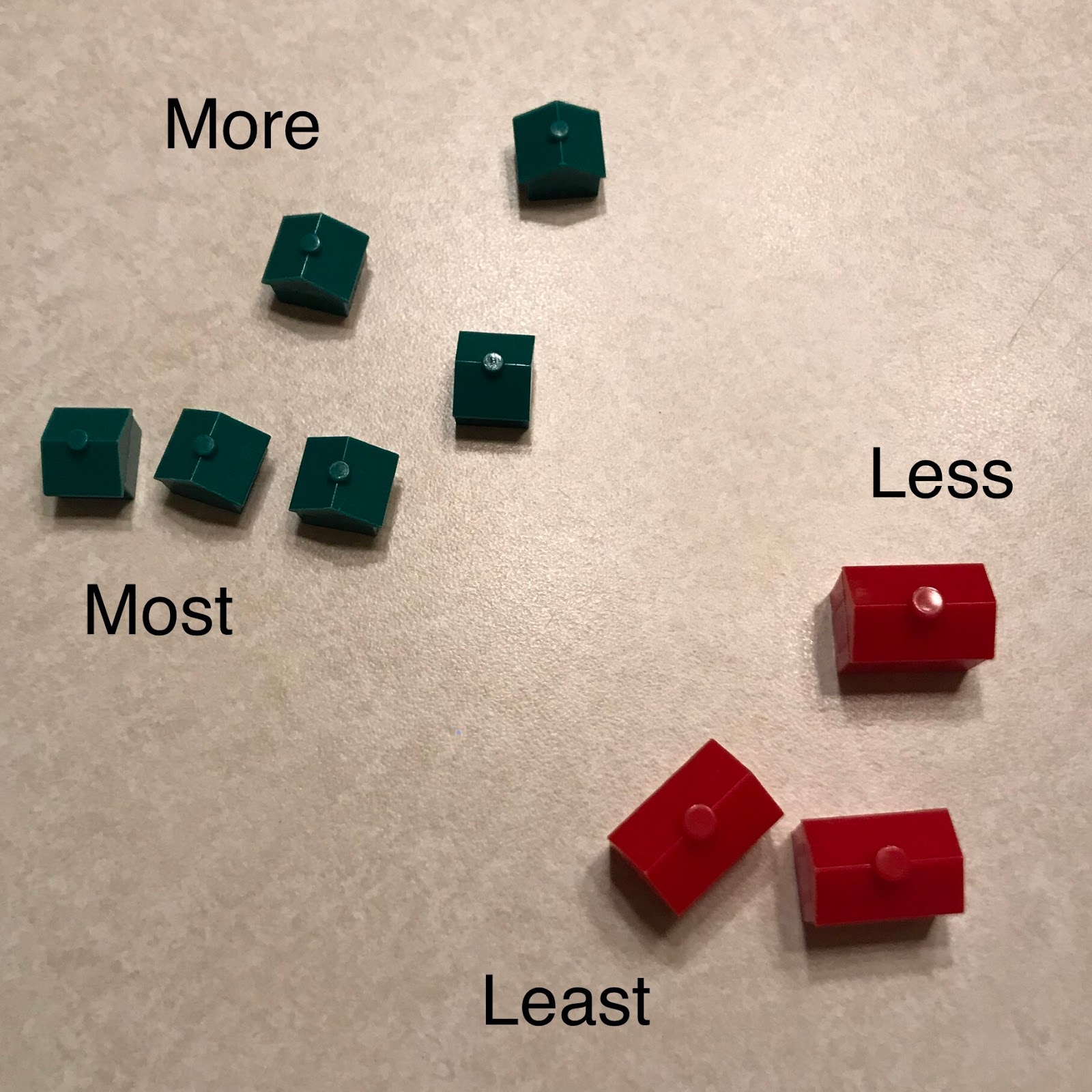 Find an old Monopoly game, or another game with multiple pieces, to use them as your own "math manipulatives." Grabbing amounts of green houses and red hotels, sorting them and finding the totals, will help your child with those skills. Then, add in the math language of "most" and "least" to bring those concepts home :) You might have other toys or games around that can be repurposed for these lessons. Any time you can engage your child in moving, finding, collecting - this will help them learn.
 In our house, buttons were always a fun manipulative, as were popsicle sticks. As a teacher and crafter, popsicle sticks were easy to store, and fun to explore with. In our Kindergarten classroom, we used them to count the days of the year, making "bundles" when we reached a group of ten.
 Trying this at home may solidify the concepts of higher numbers for tactile learners ... 5 "bundles" (or tens) and 2 "extra" or "all by themselves" (or ones) would be 52. To compare higher numbers to find out "most" and "least," making bundles and extras and touch each one as you count. Your child may understand these bigger numbers better when they can see quantities with their eyes and touch them with their fingers.
By playing with the numbers using games and game pieces, and writing down/matching with corresponding numerals, math becomes more concrete!
And, more fun!


