The first few days of school can be overwhelming - for everyone! To get to know your students, have a multi-day project ready to work on where you can pull students one-on-one and have them dictate words to go with some fun pictures!
Make an "All About Me" booklet, using half sheets of paper with specific prompts, one a day, such as ...
My name is ________________.
The people in my family are ____________________.
I am ______ years old!
I like to eat ________________ and __________________.
My favorite story is ________________________.
The toy I like to play with is __________________________.
... and leave space on each page to have them draw a picture to correspond with what they tell you :) Make some copies of a cover and let them do the design work to individualize it!
When the days you have allotted are up, you will have new knowledge about each of your students, as well as some great information about their speech sounds, small motor development, attention span, verbal ability, etc. ... and they will have a BOOK!
Win, win! Have fun!
Monday, September 12, 2011
Saturday, September 10, 2011
Name Games
At the beginning of each school year, getting to know your students is always fun ... now add some digital photos to help them get to know each other!
Even before your younger learners can read names, they can begin to recognize photos and start associating them with the letters of the names connected to them!
Start your new school year off with a quick close-up of each student (get permission from parents!) and use it to label various things in your classroom. A check-in board is a likely first place ... and a helper chart! Attach a photo to placecards before laminating and you'll have your students sorted out in no time! Friends will be excited about identifying each others' names and helping them find their seats :)
Later on, set up a box of letter tiles (available at office/teacher stores or use old Scrabble tiles) and namecards with photos. Children will enjoy figuring out which letters make up each others' names. Use this to launch a center which later can graduate to include basic sight words and vocabulary, also using photos or illustrations - it will be a big hit!
You will find lots of other uses for these photos through the school year - have fun with it!
At the end of the year, take another photo and pair them in a project to show how much growing has taken place!
Even before your younger learners can read names, they can begin to recognize photos and start associating them with the letters of the names connected to them!
Start your new school year off with a quick close-up of each student (get permission from parents!) and use it to label various things in your classroom. A check-in board is a likely first place ... and a helper chart! Attach a photo to placecards before laminating and you'll have your students sorted out in no time! Friends will be excited about identifying each others' names and helping them find their seats :)
Later on, set up a box of letter tiles (available at office/teacher stores or use old Scrabble tiles) and namecards with photos. Children will enjoy figuring out which letters make up each others' names. Use this to launch a center which later can graduate to include basic sight words and vocabulary, also using photos or illustrations - it will be a big hit!
You will find lots of other uses for these photos through the school year - have fun with it!
At the end of the year, take another photo and pair them in a project to show how much growing has taken place!
Thursday, August 25, 2011
Back To School!
September means back to school at our house - some areas are back already - so it's time to put away the summer lifestyle and get ready for school days! Here are some things you can do to help your child get ready:
1. Start adjusting bedtimes/wake-up times if they've changed a lot in the summer holidays. Small shifts over time work better than ... WAKE UP!! out of the blue 😉
2. Think about the volume of communication that will be coming home shortly and come up with a way to handle it quickly and efficiently ... a binder, basket, magnet clips ... whatever you think will keep things organized and at your fingertips. Try to return papers as they come home to avoid build-up and stress!
3. Check your school's website for calendars, supply lists, reading lists - many schools are going paperless and there may be useful information posted already! Any information you have ahead of time will make the transition into school easier.
4. Work out a morning routine, complete with a schedule and expectations, and get your child involved in setting it up - the best way to avoid those early morning melt-downs is to have a clear picture of what needs to happen and then, to follow through - start the year out as you want it to continue.
5. Come up with a short list of lunches/snacks that will work for your child and try to keep options stocked and available as your fall-back when you're not feeling creative and you don't have a plan - keep it simple!
6. If you haven't seen school friends all summer, set up a lunch or play date with a friend or two to ease the way back into school - comfortable children always do better in school :)
7. If you've slacked off reading and writing during the summer, begin reintroducing short periods when your child can spend some time engaging in these activities and reconnecting with the elements of literacy.
8. Chances are that your children will be asked to draw and/or write about their summer when they start school - generate some ideas through discussion, so they can feel confident about their first assignments. Have them reflect on photos or play "remember when..." to get them started.
9. Stamina can be an issue after a long, lazy summer - get moving and walk, bike, run with your child to increase their (and your!) stamina for those longer periods of time when they will need to focus.
* This would be a great time to cut back on the screen time :)
10. Positive statements about school, friends, teachers, experiences will help your child look forward to the days ahead - focus on the positive instead of dwelling on the end of vacation and you will be happy when your child is happy, too!
Enjoy! Have fun!
1. Start adjusting bedtimes/wake-up times if they've changed a lot in the summer holidays. Small shifts over time work better than ... WAKE UP!! out of the blue 😉
2. Think about the volume of communication that will be coming home shortly and come up with a way to handle it quickly and efficiently ... a binder, basket, magnet clips ... whatever you think will keep things organized and at your fingertips. Try to return papers as they come home to avoid build-up and stress!
3. Check your school's website for calendars, supply lists, reading lists - many schools are going paperless and there may be useful information posted already! Any information you have ahead of time will make the transition into school easier.
4. Work out a morning routine, complete with a schedule and expectations, and get your child involved in setting it up - the best way to avoid those early morning melt-downs is to have a clear picture of what needs to happen and then, to follow through - start the year out as you want it to continue.
5. Come up with a short list of lunches/snacks that will work for your child and try to keep options stocked and available as your fall-back when you're not feeling creative and you don't have a plan - keep it simple!
6. If you haven't seen school friends all summer, set up a lunch or play date with a friend or two to ease the way back into school - comfortable children always do better in school :)
7. If you've slacked off reading and writing during the summer, begin reintroducing short periods when your child can spend some time engaging in these activities and reconnecting with the elements of literacy.
8. Chances are that your children will be asked to draw and/or write about their summer when they start school - generate some ideas through discussion, so they can feel confident about their first assignments. Have them reflect on photos or play "remember when..." to get them started.
9. Stamina can be an issue after a long, lazy summer - get moving and walk, bike, run with your child to increase their (and your!) stamina for those longer periods of time when they will need to focus.
* This would be a great time to cut back on the screen time :)
10. Positive statements about school, friends, teachers, experiences will help your child look forward to the days ahead - focus on the positive instead of dwelling on the end of vacation and you will be happy when your child is happy, too!
Enjoy! Have fun!
Wednesday, August 3, 2011
Books to Love: "The Little House" by Virginia Lee Burton
Virginia Lee Burton's "The Little House" is one of those books that has been around forever but still captivates new readers every year! It was first published in 1942, but seems timeless - even as it lays the groundwork for some cool history lessons! I loved it as a little girl (a long time ago!) and I love it now!
Children will be fascinated by the changes in the same old scene, as the days, nights, seasons and years pass. They will see for themselves how the old saying, "The grass is always greener ..." is proven false, as the city encroaches on the little house in the country. Depending on their age and experience, great discussions about the balance between progress and protecting our environment could take place - "progress" is another theme of the story.
There are so many different lessons contained in the text and pictures - changes in clothing, transportation and types of neighborhoods, cycles of day and night, seasons and years - every time you pick it up you can focus on something new!
For a seasons lesson, divide large paper into four, with four little houses, and have the children decorate accordingly ...leaves sprouting, sun shining, leaves changing, snow falling, ...
If your reader has a great imagination, have them take on the "personality" of one of the big buildings toward the end of the story and tell a story from the building's point of view! Stretch those story-telling brains!! Make sure to illustrate it, as well :)
Monday, August 1, 2011
Character Book Bags
Plush toys that represent characters from books that kids love are so much fun! Curious George, Clifford, Franklin, Madeline, Babar and Mouse (from the Mouse and the Cookie books) are all currently in my collection, to name just a few! Children love to hold them as we read books - it makes reading personal and gives them a tactile connection to the story!
Then, when your visit is done, pack it all up - character, notebook and books - in some kind of bag, suitcase or backpack and pass them along to a friend. Have your character spend a night or two with a few different friends, following the same process, and eventually come back to see you again - you'll have fun reading all about his adventures!
Some friends might like to include photos of his adventures - my "Curious George" visited zoos, stores, beaches, the firehouse ... he was strapped into carseats, strollers and tucked in at night ... the opportunities are endless for traveling about! Use your imaginations!
Other friends might like to draw a picture and illustrate the "adventures" of whatever character you choose to travel around. Get some cutting and gluing practice in if you're adding something to the travel notebook and you might attempt a few letters or words of your own story, if you're able! You and your friends will be the authors of a fascinating travel book when you're all done - then, do it again!
Have fun!
Tuesday, July 19, 2011
Simple Travel Games
To get started you will need:
Plastic Sheet Protectors (I Love These!!)
A clipboard (kids love clipboards!)
Dry-Erase Markers
To play the Traffic Sign Find Game, find Clip-Art of different traffic signs that you might see on your travels - make them up into a page and make as many copies as you want. Insert in a plastic sheet, attach to a clipboard and, as each new sign is sighted, the player will check it off with a big X!! It keeps them busy and helps with visual discrimination. You can sneak in a little math by counting how many signs found? how many left to find? and by discussing shapes and colors! When you've found them all, just erase with a swipe of napkin or tissue and start again!Use the same format for the Letter Find Game!! Make up a sheet of letters - you can make them all upper-case for beginners or change up the cases and fonts if your children are a little older - and follow the same procedure! Check road signs, store signs, even signs on trucks, etc. ... some letters are REALLY hard to find!!
A blank piece of white copy paper inside a sheet protector can also serve as a write and wipe board for practice of letters, numbers, names - or for drawing on!! Your children will come up with all kinds of uses!!
Have fun!
Wednesday, July 13, 2011
Summer Camp: Pirate Play!
Playing Pirates is always a BIG hit - with boys and girls! Gather some props to make a pretend pirate ship - a large box to decorate would be great, but just arranging some chairs together and tying on some black streamers or fabric to connect them will give your children a place to gather! Add a paper-plate ship's wheel and they will be set to go!
Get in a bit of geography by having a globe on hand and spinning it to choose where you are setting sail for. Have the children find "home" on the globe as well! If there's no globe available, a large map will do :)
Every pirate needs a spyglass, so each child should start out with a paper towel tube and decorate accordingly - use markers or stickers to make them really cool! There are lots of clip-art pieces on Google images to try out - pick a few and assemble!
If you have any eyepatches lying around, or other pirate regalia, put them out in a dress-up bin - try some all-purpose vests turned inside out and some old shirts cut with ragged edges to make pirate gear! A sash cut from red and white striped fabric or an old scarf pulls the whole look together!
For more crafts, supply a key with simple mapping symbols and paper and markers for the children to make some maps - don't forget a big X to mark the spot where the treasure is! If you're looking for more fine motor practice, you can find free pirate coloring sheets at several sites on the internet, as well!
Before all the fun begins, come up with a "treasure" to be split between the pirates - beaded necklaces from the party store and "gold" coins work well - and hide it all in a special container somewhere. Then, devise some clues that will guide the group from place to place, each time to find the next clue until the end of the hunt! Here are some to get you started:
(attach a rolled up REAL treasure map to the last clue - ready to point out where you’ve hidden your “treasure"!)
If your treasure includes some gold coins, get in a little fun "arrrr"ithmetic - counting and adding up sums!
For snacks, try some "treasure" goldfish crackers in silver cupcake papers or some pretzel logs and fruit roll-ups cut up to form into a pirate ship - fun!
Books to read with your little pirates:
"Shiver Me Letters: A Pirate ABC" by June Sobel
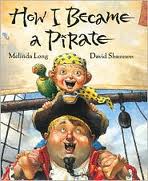
"How I Became A Pirate" by Melinda Long
"The Night Pirates" by Peter Harris
"Tough Boris" by Mem Fox
"Grandma and the Pirates" by Phoebe Gilman
"What's Inside a Pirate Ship"
Have a great time!
Get in a bit of geography by having a globe on hand and spinning it to choose where you are setting sail for. Have the children find "home" on the globe as well! If there's no globe available, a large map will do :)
Every pirate needs a spyglass, so each child should start out with a paper towel tube and decorate accordingly - use markers or stickers to make them really cool! There are lots of clip-art pieces on Google images to try out - pick a few and assemble!
If you have any eyepatches lying around, or other pirate regalia, put them out in a dress-up bin - try some all-purpose vests turned inside out and some old shirts cut with ragged edges to make pirate gear! A sash cut from red and white striped fabric or an old scarf pulls the whole look together!
Before all the fun begins, come up with a "treasure" to be split between the pirates - beaded necklaces from the party store and "gold" coins work well - and hide it all in a special container somewhere. Then, devise some clues that will guide the group from place to place, each time to find the next clue until the end of the hunt! Here are some to get you started:
Treasure Hunt!
Cut these clues apart and hide them as directed – or make up your own!
Under the fence where the squirrels run (have this ready to start the action!)
Look for clue #1!
Find a toy that’s the color blue – that’s (hide this under a fence!)
Where you’ll find clue #2
Look around the base of the big tree (hide this under or near a blue toy!)
If you’re looking for clue #3
Beside a window or a door, (hide at the base of a tree!)
You will find Clue #4
Look under a rock or two (hide beside a window or door)
To find the fifth and final clue!
This clue will send you around the lot (hide under a rock)
Until you find where X marks the spot!
If your treasure includes some gold coins, get in a little fun "arrrr"ithmetic - counting and adding up sums!
For snacks, try some "treasure" goldfish crackers in silver cupcake papers or some pretzel logs and fruit roll-ups cut up to form into a pirate ship - fun!
Books to read with your little pirates:
"Shiver Me Letters: A Pirate ABC" by June Sobel
"How I Became A Pirate" by Melinda Long
"The Night Pirates" by Peter Harris
"Tough Boris" by Mem Fox
"Grandma and the Pirates" by Phoebe Gilman
"What's Inside a Pirate Ship"
Have a great time!
Subscribe to:
Posts (Atom)