Saturday, May 9, 2020

Remote Learning: Growing Things (With What You Have at Home!)


Want to grow something and show your children at home the process?

No seeds? No problem!!

Don't despair if the sunflower project you always do in the Spring isn't able to work with Remote Learning! Look around at what you (and your students!) already have at home - you'll be surprised what you (and they) can do when you start thinking outside the box :)


Soon after we realized we weren't going back to the classroom anytime soon, I looked around at what I had - in my fridge, my pantry, on my block ...

The first thing I tried was rerooting romaine lettuce. I had a package of lettuce with the stalk part still attached and I had seen a YouTube video showing how to regrow the lettuce. I can't believe how simple this was! Just cut the lettuce about 1 1/2 inches from the end and take the stem piece and set in water in a small container. Overnight, I could see the regrowth. Change the water daily and within a week or two, you'll see roots start to appear. Plant in dirt and watch it grow!


Seeds from an apple were next, after eating it, of course. I put the seeds into a sealed plastic bag in the sunlight, with a small, damp paper towel and waited to see what would happen. This took longer, but after about 7-8 days, roots and a stem started to appear. A few days later, it was transplanted into dirt and continues to grow :)


Look around your environment, too, not just in the house! These "helicopters" fall from a tree near me every year, so into a bag they went, and .... after two weeks (patience!), a small root system was kicking in!


Carrot greens can be grown from the tips of carrots - good for seasoning and garnishing :)


To grow potatoes, I cut a section of a potato that had some growth at the eye, and put that in a plastic bag, too. I left it in a sunny window, and forgot about it ... until this root system caught my eye :)


No seeds, no problem! You can teach and they can learn - using things that are already around in the home!

Have fun!


Wednesday, April 22, 2020

Remote Learning: Look for Sight Words All Around!

Part of learning to read is to quickly recognize some words - the words we call "sight words." Each grade level has an expected list, and each class does things a little differently, but there are lots of small, simple words your child will begin to recognize, especially with fun ways to practice them :)

One resource that is available to you at home is the use of what we call "environmental print." It's the print that you see on packaging, newspapers, magazines, signs, etc. Before you throw away your recyclables, I have a fun "game" for you to play at home :)

Show your child the box or paper, and see if they can find any words that stand out, either alone or as part of (a chunk of) another word .... let's call it a WORD HUNT! Once you've found something, cut it out! I found all these words on my Raisin Bran Crunch box this morning, before I recycled the rest  :)


For another step, you could tape or glue these words onto index cards, or cut up cardboard (use the flip side of the box!) and you have brand new sight word cards! If you find matching pairs, you could do WORD MATCH! I found all of these - I know there are some matching words in this pile!


SILLY SENTENCES is the next game ... arrange the words in sentence lines to try to make sentences. Sometimes they make sense, sometimes they are just silly!! You might have to make some additional people, place or thing (noun) cards or action (verb) cards to form some complete sentences. Let your child draw pictures and help them sound out the corresponding words, so then they can use these when they have sentences to write for assignments.


Most of all, they will get used to looking for these words in the environment, tuning into literacy all around, and having fun with it!


Tuesday, April 21, 2020

Remote Learning: Math - Use What You Have!

Sometimes Math concepts are hard for our little guys and we have to look through their eyes to find ways to make it all make sense. Making it fun is always best, as is applauding small successes as steps along the way :)

In these times of being home during learning times, we have to be even more flexible in how we approach "lessons" :) Look around with fresh eyes for available tools already in your home :) Use things that you find to make math lessons more concrete. For starters, if your child benefits from using tactile methods of teaching, pull out a deck of cards and rustle up some old game pieces.

Get out your playing cards for a simple game, that will explore counting, ordering, and more and less.


Each player gets a stack of cards and turns over one at a time (like the old War game). Each player takes a turn to count the objects (diamonds, hearts, spades or clovers) on their card and touches the numeral in the corner of the card, saying the number. Then, use math language like "most," "more," "less'" and "least." e.g. "I have 9 and you have 5. I have more than you."

Another form would be to lay out three or four cards, count them each up and order them, naming them as "most" and "least." If your child guesses correctly, they get the cards. Getting these concepts down with smaller, one-digit numbers will be to your child's benefit, before moving on to larger numbers. Down the road, you can make higher number cards from index cards, and play with them.

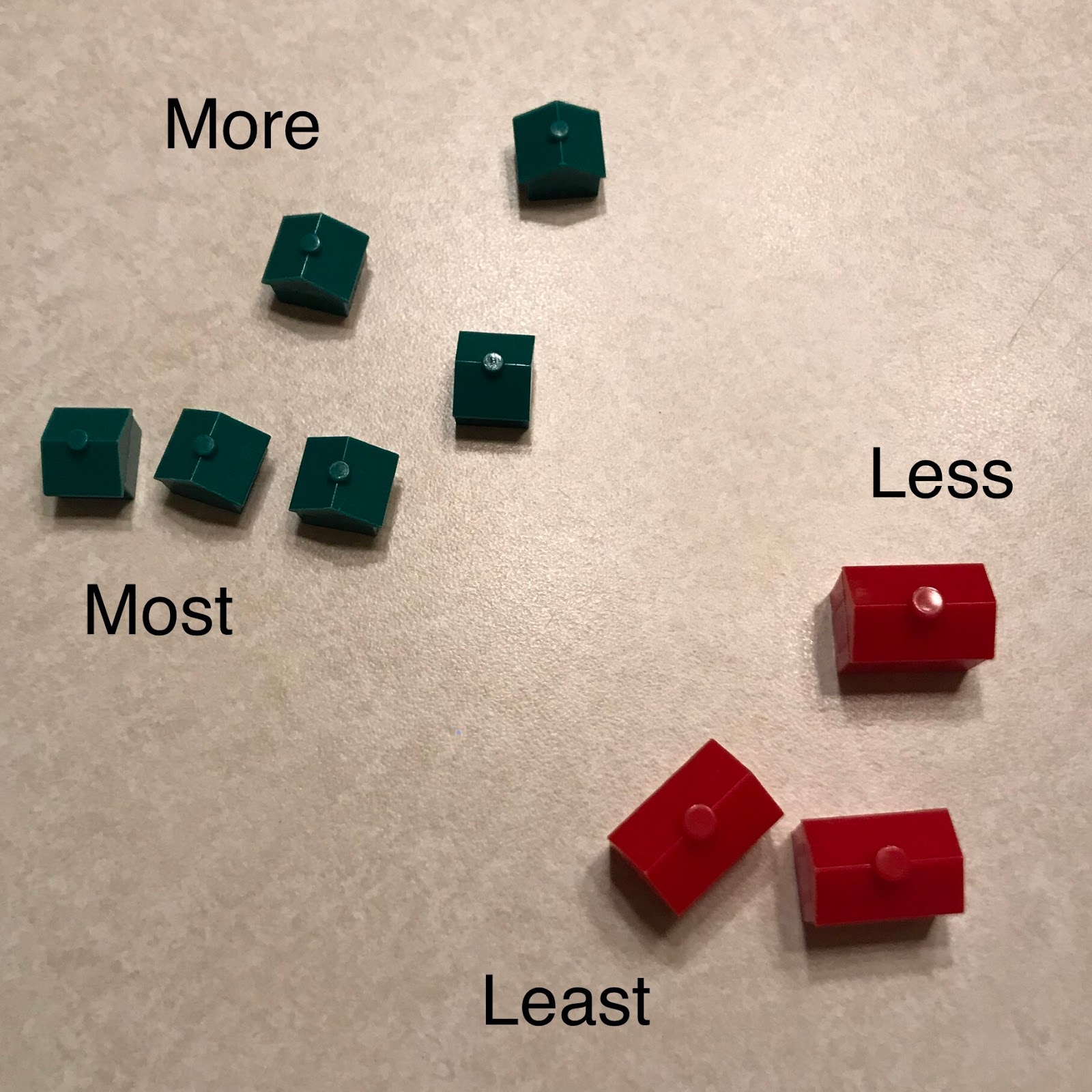
Find an old Monopoly game, or another game with multiple pieces, to use them as your own "math manipulatives." Grabbing amounts of green houses and red hotels, sorting them and finding the totals, will help your child with those skills. Then, add in the math language of "most" and "least" to bring those concepts home :) You might have other toys or games around that can be repurposed for these lessons. Any time you can engage your child in moving, finding, collecting - this will help them learn.

In our house, buttons were always a fun manipulative, as were popsicle sticks. As a teacher and crafter, popsicle sticks were easy to store, and fun to explore with. In our Kindergarten classroom, we used them to count the days of the year, making "bundles" when we reached a group of ten.

Trying this at home may solidify the concepts of higher numbers for tactile learners ... 5 "bundles" (or tens) and 2 "extra" or "all by themselves" (or ones) would be 52. To compare higher numbers to find out "most" and "least," making bundles and extras and touch each one as you count. Your child may understand these bigger numbers better when they can see quantities with their eyes and touch them with their fingers.

By playing with the numbers using games and game pieces, and writing down/matching with corresponding numerals, math becomes more concrete!

And, more fun!


Thursday, March 26, 2020

Remote Learning: At-Home Literacy (Fun!) Challenge

Looking for ways to help your child branch out in their literacy skills, while they're home?

Try putting the kids in charge :) This is a multi-step, fun project that could be broken down over several days :) They will learn about characters, setting, adding details, writing down information, making choices about writing, and compiling notes into a "report." All while having fun ....... :)


Step1:

Get out some art materials and design a character (animal or person) to write about. (They may be able to do this alone, or need help with outlines or models, depending on their age and/or ability. Sometimes just drawing a simple outline with shapes will help them get started...)

I picked a mouse for my character (and he has a lizard friend!) ... maybe you will choose a bear, a person, a snake, or something else. Look at books to get ideas, if you need to. Use colors and add details to make your character super cool! Definitely come up with a name for your character! When you're done, cut your figure out.

Step 2:

Design your character's "house." Find a small box or envelope (bigger than your character) and draw on the outside, making it into the type of place that your character would live in. Add pictures of accessories and cut them out to tuck them in, if needed/wanted.

Step 3:

Find some writing paper - computer paper, paper from a notebook, whatever you decide on will be great! Fold it or cut it into smaller pieces - either quarters or strips. I cut mine into strips so I could write across and then fold it up later to fit in my "house."

Step 4:

Decide on a list of questions that you want to answer about your character. Think about what your character looks like, what their house looks like, what his/her family is like, what their favorite color is, what they like to eat, play with, etc. If you need help, ask a bigger person to write them down. 

Step 5: 

Take one question at a time and write about your character. When all questions are answered, ask some more questions and write some more answers :) It could be as simple as "Snakey has no feet and is green," or much more detail, if you're older. Small friends can do this with a big friend. 

Step 6: 

Write an introduction, as if you were introducing your character to a friend. Line up all your writing pieces and decide which piece of information should go first, next, last. Put it all together into a book about your character. Staple or tape together, or rewrite if needed.

Step 7:

Make a cover and have an author's reading with the family - sit in a special chair and read aloud. Consider recording it on audio or video and sharing :)

So, you have your character forever now ...
maybe they'll take some adventures next ... !

Have fun!

Thursday, March 19, 2020

More free resources (Part 2)

Everyone is getting very creative but just in case you’re looking ....
More resources ....

On FacebookLive - check out PhillyZoo at 2 each day.

Audible books for all ages - https://stories.audible.com/start-listen

Aquarium live cams - https://www.montereybayaquarium.org/animals/live-cams

San Diego Zoo also has live visits with animals on Facebook and FacebookLive.

Children’s Museum of Indianapolis is offering fun videos and activities for kids https://www.childrensmuseum.org/museum-at-home

Children’s Museum of Pittsburgh has maker projects on its Museum at Homepage https://pittsburghkids.org/museumathome

Have fun!

Tuesday, March 17, 2020

Free in-home learning resources: during Coronavirus 2020

While we are all adjusting to our new schedules, and learning how to adapt to doing things differently, so many resources are being made available to families to facilitate in-home learning. Check these links (subject to date/time restrictions) to find ways to extend your child’s learning :)


For extensions in Literacy, take a look at:

Storyline Online.  https://www.storylineonline.net/about-us/

Seussville  https://www.seussville.com

Oliver Jeffers ("The Day the Crayons Quit") is doing daily Instagram read-alouds, and Peter H. Reynolds ("The Dot") will be on FacebookLive. Check for your favorite authors on social media - more and more are stepping up.

PenguinKids is doing a daily read-aloud at 10am ET on InstagramLive, so check them out, too :)

YouTube has an amazing assortment of books read aloud by teachers and others, if you're looking for a particular favorite. Many local libraries are also operating online, even if they are closed to the public.

For Math, there are Math games and lots more ... at https://www.education.com/

Interested in Science? Mystery Science (mysteryscience.com) is opening up for free for all different ages, and Scholastic.com has a great library of videos to view on many different topics.

Don't miss a daily visit on FaceBook Live with the Cincinnati Zoo :) 3PM
https://www.facebook.com/cincinnatizoo/

Looking for Dance and Exercise fun? Try these ...

Ballet:  https://www.clevelandinnercityballet.org/single-post/2020/03/14/Cleveland-Inner-City-Ballet-to-launch-Virtual-Online-Ballet-Instruction-Program

Yoga: https://www.youtube.com/user/CosmicKidsYoga

All the budding artists can join Mo Willems for his Lunchtime Doodles at 12N ET:
https://www.youtube.com/watch?v=RmzjCPQv3y8

Many museums and performance art establishments are working on getting their content out to the public. Check as the days go on to find even more things to do :) I saw this compilation of at home things to do/view, but always preview before having kids jump in :)

https://www.cnn.com/style/article/what-to-do-at-home-streaming-art-museums-concerts-coronavirus-trnd/index.html

Have fun with your exploring time!


Note: all info subject to changes

Saturday, February 15, 2020

Small Steps Towards Equity and Inclusion

Teachers (and parents) can broaden children’s experiences through thoughtful, inclusive choices in both literature and in choosing topics for project-based learning. Seeing a range of people reflected in books, and opening up topics that are inclusive, where everyone can contribute and feel connected, are just two ways to honor and celebrate the differences among us.

All children need and deserve to see themselves in books - to feel a part of the world represented in literature, through illustrations and photos. If they do not, they won’t necessarily feel the connection to literature as a whole and to specific stories that may reflect or expand their experience of the world. Children should also be looking at illustrations and reading stories that broaden their view of different cultures ... there is a wealth of great books out there to choose from.


It’s easy to find book lists that are inclusive and expansive, depicting children of all races, cultures, ethnicities, etc. Books that also show characters with disabilities, varied family structures, and in different living situations are so important, as they normalize things for children who may feel marginalized in some way.

In order to feel truly a part of play and learning situations, children must also be able to make connections to the materials featured in the classroom. Choosing topics for group activities that level the playing field opens the door for children with differing backgrounds and experiences to meet on common ground. Topics that are drawn from nature, for example, allow all children ... those who are learning a new language, those with special needs, those with fewer background experiences, even those with trauma in their past ... to join in and contribute.

Common subjects like leaves, snow, planting, motion ... the typical “science” explorations have shown to be great equalizers in our class. Using these types of topics to launch new vocabulary, build knowledge, and explore common questions, helps our students all get involved in the topics we explore. Using these projects to bring together all of our children has helped make our classroom a community, and give each child a voice. And, it has been a very happy voice!

Have fun - and promote equity!