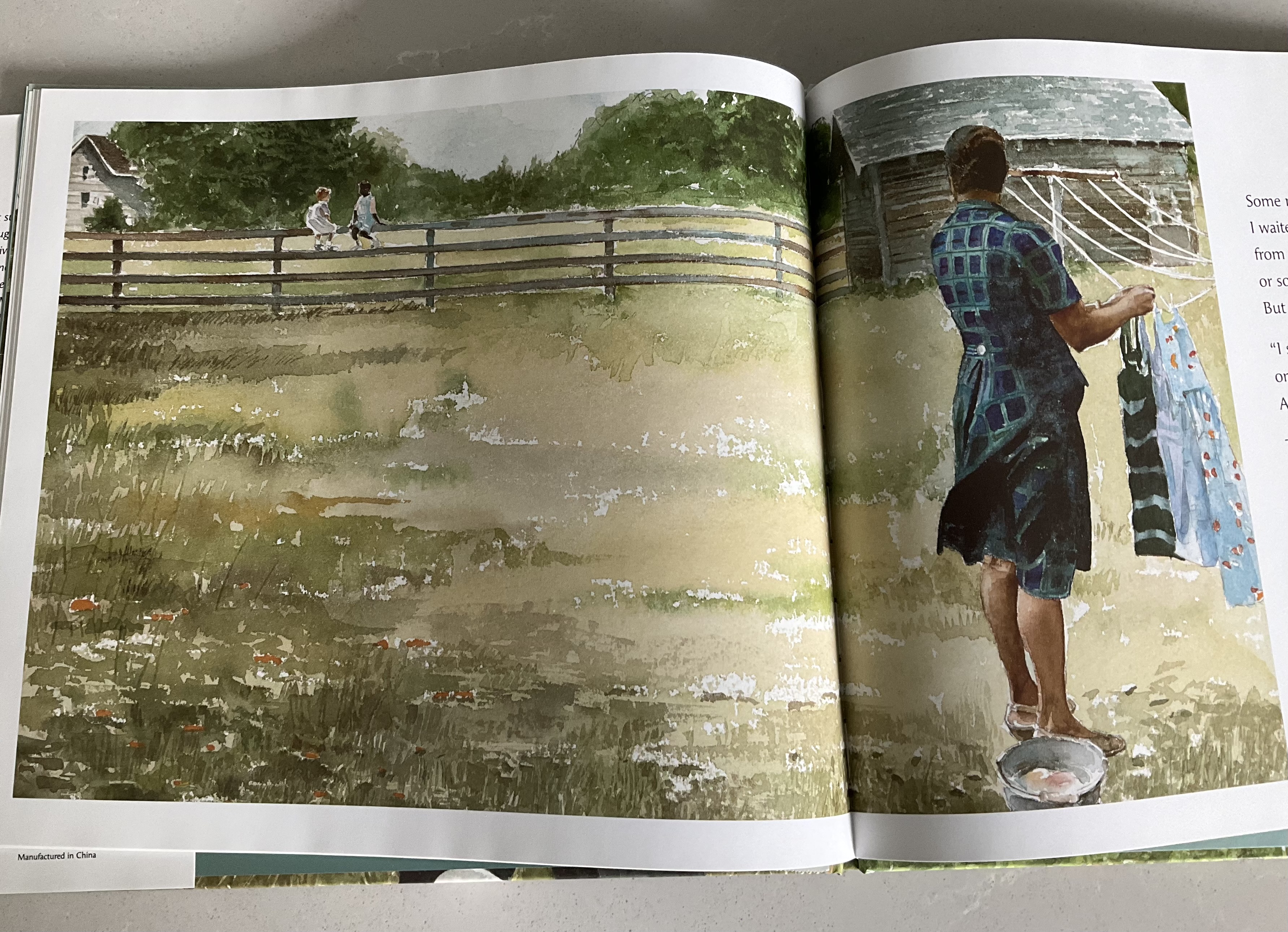
The illustrations add to the perspectives in the book, and, when simply doing a picture walk through this book, you can see the story unfold. The message is deep and the seeds of hope it sows are so important to share with our upcoming generations.
Sunday, August 4, 2024
Book Choice: The Other Side by Jacqueline Woodson, illustrated by E.B. Lewis
The illustrations add to the perspectives in the book, and, when simply doing a picture walk through this book, you can see the story unfold. The message is deep and the seeds of hope it sows are so important to share with our upcoming generations.
Monday, October 23, 2023
Celebrate Diwali with Read-Alouds!
When children see their culture represented in books, it can promote inclusivity and self-worth. Being able to share parts of their lives at home and have others interested in the holidays they celebrate may make students feel more accepted and comfortable in the group.
When children learn about many cultures and different holidays, it helps them to appreciate the world and the people around them. Introducing your children to a variety of cultures, via the gift of reading, is one step to raising culturally sensitive humans.
Diwali is a major holiday celebrated by people of Hindu and other faiths, and is a major holiday in India, similar to Thanksgiving or Christmas in the US, according to National Geographic magazine. It is typically in late October or early November, November 12th in 2023. Here are a few titles to get started with at an early elementary, even preschool, level.
Saturday, October 21, 2023
Painting Some Pumpkins :)
When there’s (finally!) a bite of fall in the air, pumpkins start popping up everywhere! There are so many cool lessons to enjoy involving pumpkins, such as those linked here: https://makeearlylearningfun.blogspot.com/2020/10/we-are-scientists-pumpkin-exploration.html and https://makeearlylearningfun.blogspot.com/2012/10/pumpkin-fun.html
For some Art interest, there is nothing like simple process painting for the little ones. Before their hand-eye coordination is fully developed, it’s still fun to work with paints to get that squishy feeling - either with hands, brushes or even sponges or other objects.
Let them cover a paper with paint however you choose and after the page of orange painting dries, you can use thick cardboard stencils (cereal boxes?) cut in large pumpkin shapes to help them make lines and start to cut out their pumpkins!
Make sure they’re on board with cutting into their artwork - modeling the process first will help them understand. Decide how to display - hanging by some yarn, taped on the wall or window, stuck on the fridge?
Of course, kitchen sponges cut in the shape of pumpkins would be fun - your kiddos can print a whole field of pumpkins and fill in with drawn vines and leaves.
Apples, cut in half, give a nice pumpkin shape, when dipped in paint and printed. Try using apples that are not super edible to avoid food waste.
Not looking to get out the paints - or need a quicker craft? Try large orange ink pads and spongy pumpkins to get a similar effect.
Sometimes, though, you just want to paint on an actual pumpkin! We got the markers out for this one - fun was had by all!
Thursday, October 19, 2023
Pumpkin Day Feelings!
Big emotions like mad, sad, scared, surprised are represented here …. Even silly! You can use this book to make your own little flip books with some blank pumpkin shapes and have your littles fill in some emotional faces - simple lines that will help them show feelings, like the emoticons they are so used to seeing everywhere.
Use some small mirrors to have them try to see their own faces showing these emotions. The more they become familiar with naming how they are feeling, the more insight you might get during a difficult time when they are having trouble regulating their own emotions. Saturday, March 11, 2023
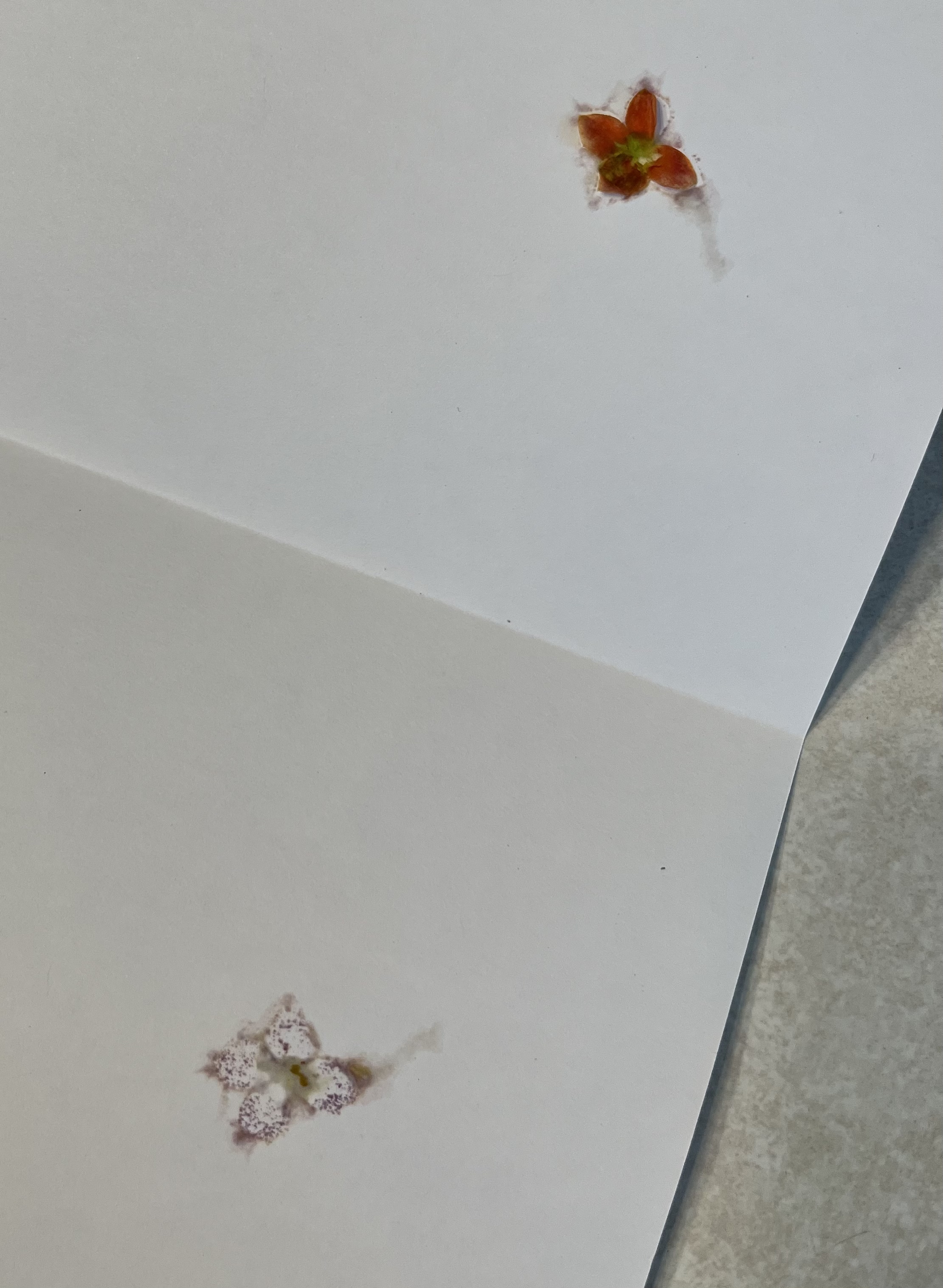
Printmaking with Nature
As the weather warms up here, everyone wants to be outdoors, especially the kiddos. Looking for lessons that can be done outdoors is one way to satisfy that longing for fresh air!
Printing with the colors of spring is a delicate process but has so many benefits for your littles. Teach them to retrieve the flower parts that have fallen already, or those that are in abundance or wilting, so as not to take away what animals and insects need :) Talk about food chains in the simplest terms and about how important all of the pieces of the chain are.
It is also a great time to talk about having respect for growing things, and to give the plants a chance to survive and thrive. Children are capable of being very gentle and should understand their impact on gardens and wildflowers - respect for all nature! :)
Bring paper and rolling or pounding tools (maybe from playdoh or kitchen sets) outside. Demonstrate how to place the plant material gently between the folds of the paper and press, or pound, the color onto the paper - and then check out what you have made! The color and shape may transfer or become another shade when pressed on the paper. Very wet flowers and leaves won’t work for you, and dried leaves or plants are too brittle to transfer well.
Trial and error (or success!) is a great practice for children, as they need to learn stamina in experimenting. Watch for students who are willing to share information and partner them with those who may need some encouragement.
This can be a great team building experience, as you hopefully see empathy and excitement build for all the group to be successful. As children learn to work together, they can experience great self-image and feel good about cooperating. Encouraging these traits through play and creating is THE BEST!
And, as always, have fun!
Wednesday, July 27, 2022
Modeling Quiet Time
There are so many distractions in the current world and the kiddos are WOUND UP with electronics, constant programming, sports teams .... all of which have their place.
But ... it's hard for a kiddo to find a space to relax, unwind, and just think.
These days, grown-ups are suffering from the same "affliction," and have limited space (physical or mental) for reflection, dreaming, creating, etc.
Telling your child to have some quiet time doesn't always help them to understand what you mean by that. Like any concept, MODELING this for your children is a critical piece of teaching them to make space for their own quiet time. Take some time to show your child, by example, what quiet time would look like, sound like, feel like.- Get comfy in a chair and read an actual paper book or magazine. Recharge and take your time, focusing on something, instead of scanning.
- Take a blanket outdoors with some books and writing paper (or not) and have quiet time in the shade. Enjoy the benefits of being outdoors.
- Find a corner of the room to sit in with minimal distractions and write, diary style or free style, any thoughts you have - or doodle.
- Turn the lights down, put on some soft music and just let your thoughts wander. Regulate your breathing to lower your stress.
Let yourself enjoy some quiet time, and your child will learn that this is a great time for dreaming, relaxing … and for self-regulation. Sometimes the stress of our go-go world is too much, and having tools to decompress is important.
"Mindfulness" is a concept that has been publicized a lot in recent days. There are books, videos, audio tracks, etc. to help you on the path to mindfulness. So many folks are looking for an easier way or more time-efficient way to do things, but mindfulness (or quiet time) is not going to fit into that category. Carving out some special time to be quiet, spend time with yourself, find things that make you joyful ... this is a process.
MODEL for your children, and enjoy the side benefits of winding down and chilling out.
Have fun!
Monday, July 25, 2022
Daily Schedule for the Win!
It seems like such a little thing …. a visual schedule.
Children are used to keeping to a schedule in school, and educators have long known that posting a daily schedule (and sticking to it, mostly) can help keep students on track and alleviate questions and disagreements. At home, especially if it’s the school holidays and the days are drifting by, a schedule can help with your daily routine, too. Maybe the little transitions are turning into longer transitions, with pushback, and some tempers may be starting to flare. The b-word (BORED) may be getting
Something simple like posting a visual schedule can alleviate stress, help children make the most of their time, and ease transitions between activities. Just as in school, a posted schedule allows children to see what is coming up, how close snack or lunchtime is, and when their favorite activities are coming up. With siblings involved, it also allows for taking turns in a non-confrontational way. And, the best, the adult doesn’t have to keep tightening the reins or making decisions, and might enjoy their children more ;)Using timers has worked for us too, to give children a way to monitor how much time they have left in a time period. Even the smaller children can visualize, by using an egg timer or countdown clock, both of which you can find online.
Try this out and see if it works for you!
Have fun!
Wednesday, December 1, 2021
Thoughtful/Useful Gifts for Creative Kiddos
Consumable gifts - gifts that will get used up and not take up space forever - are great for adults AND kids! Some of my favorite gifts for adults are …
- restaurant gift cards for a night out
- collections of note cards and greeting cards, wrapped up with some stamps
- seeds and pots to plant and nurture
- specialty spices/ ingredients with a favorite recipe
…. You get the picture!
So, why not take this concept and apply it to THE KIDS! There’s something for everyone!
For your kiddo Mechanic:
Hit the hardware store for a collection of bolts and washers and screws and nuts to put in a small “toolkit” container and let your child have fun with this self-made STEM kit. Extra points if you find a small board and drill holes in it to work on - don’t forget to sand down those rough spots :)
For your little Scientist:
Put together a sturdy magnifying glass (Lakeshore has some good ones) and some plastic containers with lids. These will be collection cups - put in a sample of pine cones, seeds, shells, etc. but leave lots of room for additions by your scientists.
For your budding Writers/Artists:
A box of scrapbook paper, construction paper, and sticky notes will be exciting for these kiddos. Add in scissors, glue sticks, stick-on Googly eyes, etc. and some writing tools to complete a card or book-making kit.
For the kiddo Bakers/Chefs:
Sometimes supplies of their own inspire new hobbies! Start with a favorite recipe and add a few special utensils to create interest :) Plastic bowls and small rolling pins, spoons, recipe books, cookie cutters, and mini pans are all possibilities for baking kits. There are toy versions of baking kits or you can make your own and present it in a little cloth bag or box.
Most of all, think of all the interaction that can take place while using these kits, and have fun planning together!!
Happy Holidays!!
Tuesday, October 5, 2021
The Reading "Game"
When the kiddos ask about signs or symbols, challenge them to tell YOU what it means. Follow their lead to gauge interest and start with letters that are part of their world - letters they see every day and ask about! "What does that say?"
Point out letters casually - and make the primary sound the letter makes, as well as naming the letters. This connects sounds to letters and sparks more connections and interest.
Play games with their beginning name letters and then words that are important to them, like Mom or Dad. When the sound/letter has more meaning to them, they will likely be more interested. Interest leads to retaining information, as well.
Call attention to words in your everyday life .... Muffin! That sounds like mom at the beginning ... mom, muffin, .... what else?
******************************************************
Then, over time:
Make a word collector ... Draw boxes on a big sheet of paper or make a notebook. Add drawings or clippings from magazines with pictures of words that start with different beginning sounds.... label them and repeat them in groups, mom, muffin, mop, mountain.We had fun making matching cards for beginning sounds, using magazines and index cards - got in a little cutting and gluing practice, too! Car and candy are a match for beginning sounds, so are bed and bathroom! These were easy to find in brochures that came in the mail!
******************************************************
Keep the format loose and don't try to make perfect letters at first - there's time! Make sure when you do, that you are teaching them the right way - make your letters from the top ... pull down from the top to make tall or other letters (b, h, i, j, k, l, m, n, r, p, t, etc.) start with a letter c to make others (c, a, o, d, g, q). Making letters this way helps them later on, when they are learning how to write cursive.
Remember, have fun!
Tuesday, August 10, 2021
Baby Steps :)
Way before your child reaches preschool age, they are already learning ALL THE TIME from the world around them :) You are their first teacher!
There are many steps to child development, and many great resources to find out more about the different stages your child will go through. Each step is exciting, and should be celebrated, as your child begins to interact more with the world around them.
Reaching for a person or an object such as a brightly colored or noisy toy or rattle is one of the first interactive things a baby will do. It’s exciting the first time it happens, and every time after! :) Watch to see your baby track the noise or color with their eyes, or whole head, from side to side, and try to grab as their control becomes more developed.
Stretching out on a flat surface for tummy time is another important exercise for development. As babies gain control of their muscles, tummy time builds their neck and core muscles, which help with so many things down the line.
Following your lead in pursuing a toy and beginning to “army-crawl” or roll towards something, or someone, is another step worth waiting for. Your doctor will give you benchmarks that are indicators of your baby’s continued development - keep in mind these are averages :) Each of these "exercises" builds skills in your child that will help them, when it is time, to learn to sit in a group, write and draw, and attend to lessons.
Along with physical development, a child's "literacy" is developed over time, with baby steps from infancy on. Reading aloud to your child is one way to foster literacy. Your child will begin to equate story time with time for your attention, and with coziness. Showing pictures in the book, and reading with feeling, draws children into the story and helps them focus their attention.
There are many other ways to promote literacy in small children :)
Songs and Fingerplays introduce new vocabulary and rhyme - try “Itsy Bitsy Spider” or “Twinkle, Twinkle, Little Star.” Using simple hand motions makes it more fun and easier to remember, too! If you're a little rusty, you can always YouTube nursery rhymes, and you will be amazed at what is out there.
Puppets are another great tool in developing speech and language literacy. Begin by having puppets "talk" to each other and when your child begins to get involved, have them take on a character, or two! Even simple one word exchanges are a step in the right direction. Acting out a rhyme or familiar story is a fun way to engage your child. I like finger puppets, as they are small enough to have a variety, and easy for little ones to manipulate. Sets of puppets that go with stories are easy to find ... or make your own, using drawings and craft sticks!
Have fun!
Sunday, August 1, 2021
Car Games - Playing with Content
Riding in the car can be frustrating, boring, annoying .....or FUN! My riders get antsy at the end of the day, right before dinner, while we are riding home from day care, school, camp, or sports. Trying to keep the older ones engaged, and the younger ones from falling asleep, we've had great success with car games!
Their favorite, by far, is “Finding A to Z” - we start at the beginning of the alphabet, call out the letter, then find something along the way that begins with it! Some are REALLY hard, like Q (we found a quarter on the floor of the car!) or X (we let that one be an ending sound too!). You can make your own rules, of course!
“Shape Find” is another fav! One player calls out the shape of choice, while others have to find it in a sign, shapes like windows or doors, or even roof lines or wheels. You can also play this like an I Spy game.“I Spy” can switch to be shapes, colors, actions, etc. or a combination of these. It relies on powers of observation :) “I spy something yellow that moves…” or “I spy something that spins and is shaped like an oval …” Have fun with it!
Longer trips may require longer games - see this post for some more ideas:
https://makeearlylearningfun.blogspot.com/2011/07/simple-travel-games.html?m=1
Car rides are also the BEST places to get some one on one conversation time with little ones! If you ever get a chance, ask them some open-ended questions about what they like best to eat or play with, and maybe the conversation will help you bridge to other interesting topics :)
Have fun!
Tuesday, May 18, 2021
Books about Waiting
Two of my favorite authors have books on this topic - and there are lots more out there! Karma Wilson’s Bear series continues with “Bear Can’t Wait!” which has Bear so impatient to have a party for a friend, that he has some problems keeping it all together! He ALMOST wrecks the surprise altogether, but some teamwork pulls it all together at the end!Mo Willems’ book “Waiting Is Not Easy!” shows how hard it is to wait for something, especially when it takes awhile for it to happen! Piggie’s surprise is worth waiting for, and this book (like all the other Mo Willems books) is SO fun to read!
Sunday, April 25, 2021
Learning Outdoors
"Why not have class outside?" Easy for them to say .... ;) But ... with some prep, it can be fun and productive!
In these continuing pandemic days (or really anytime!), as the weather gets nicer in the northern hemisphere, we can look to the outdoors to supplement our classroom space, but only if our needs can be met there for safety and security :)
First, think about safety. Is the surrounding area conducive to having class outside? Are there too many distractions from heavy traffic or loud noises? Is it too sunny/shady? The physical position of the teacher (and other adults) and students is also important, as you want to make sure no one is out of sight or close to hazards (like streets or steep slopes).
Next, this plan takes some prep work for the teacher, instead of a spur-of-the-moment decision. Try a rolling cart or carry basket pre-loaded with all the supplies you might need. (A small white board, markers, some chalk, sticky notes, etc.) Students could have pre-made "seats,"such as folded beach towels or small pillows tied inside plastic shopping bags for avoiding dampness. Clipboards are always a great addition, making things "official" :)
Then, choose what part of your daily lesson would work best outdoors. Some topics really work in outdoor settings, such as:
- measurement or making patterns in math - Take your measurement tools outdoors and use objects found there to extend your lesson. Or, find natural objects outdoors to arrange and extend patterns on the sidewalk or in a grassy area.
- growing things or force and motion in science - Take these topics outdoors and plant in the dirt or in raised containers or offer wood planks and blocks to encourage experimentation with force and motion ideas. Add a few balls or toy cars and see what theories your friends can prove.
- poetry or descriptive writing or really any type of creative writing - Any age students would enjoy laying outdoors on a beach towel and writing/drawing about what they see/feel/hear.
- reading aloud with discussion - This would be great, even as a last-minute idea, and can break your day up, allowing for stretching and movement, as well.
- independent reading/paired reading (more room to spread out)/small groups - Experiment with different set-ups for reading time and spread your class out a little. Have something in mind to hold them accountable for what they are reading during this time. You may choose to pull a small group, as long as you can still monitor safety for the others.
- art with watercolor paints, chalk, recycled sculptures, nature sculptures - There are so many art projects that can be enhanced by being outdoors, and help your children connect art and nature.
Thursday, March 18, 2021
Learning with Collections: Seashells
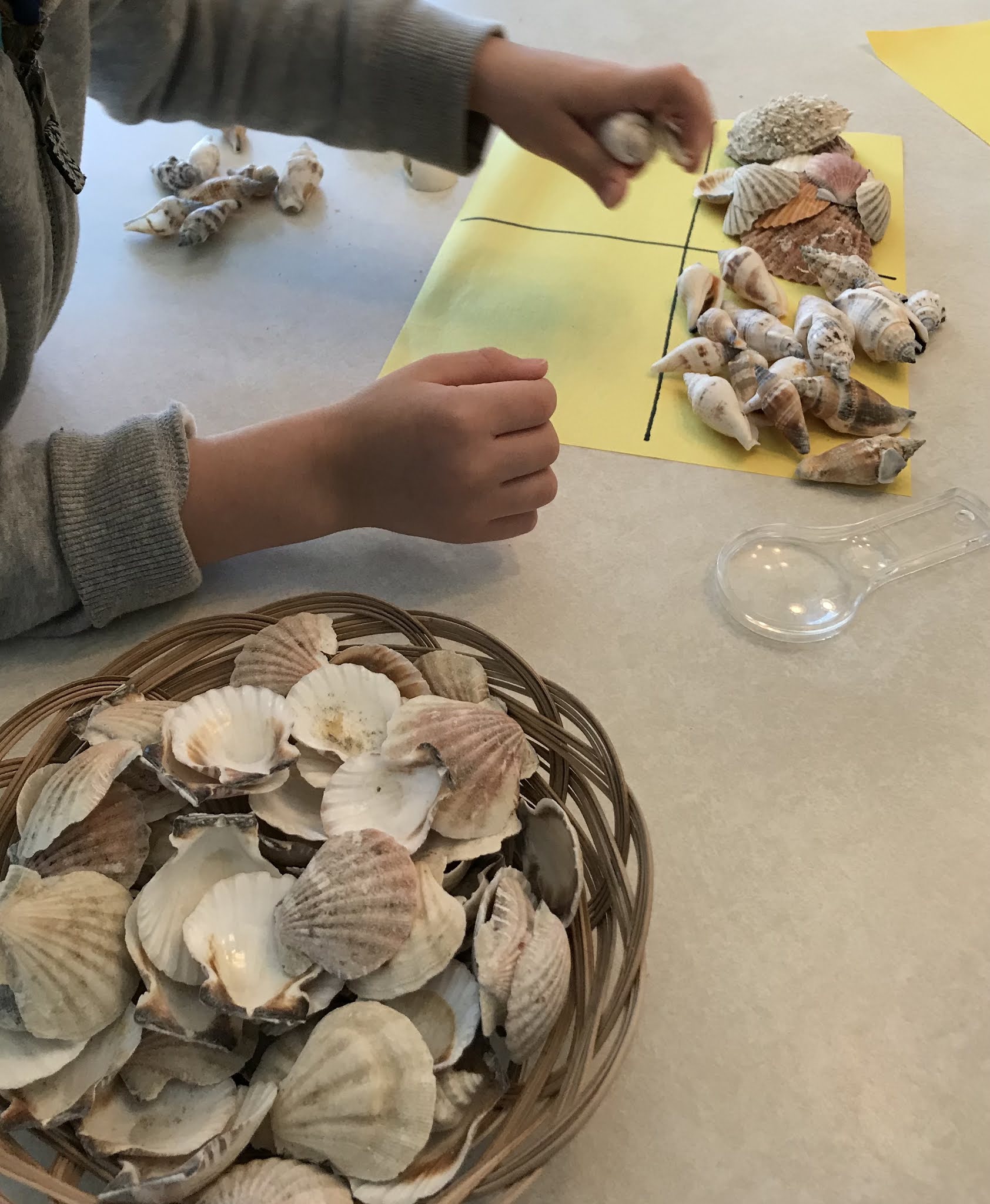
Playthings don’t have to be expensive and manufactured to grab a child’s attention, and to learn from. Nature provides many objects to observe and tinker with, and kiddos are drawn to them. Sticks, leaves, rocks ... and don’t forget seashells! (If you already have a few around, from trips to the beach, then you’re all set! If you don’t, craft stores and discount stores often have baskets or bags of them for decor projects.)
Whether your child has never been to the seashore or has visited there lots of times, seashells seem to spark curiosity and can lead to all sorts of learning. There are many shapes, sizes, and colors of shells to be explored :)
Their first inclination may be just to look closely to see the nooks and crannies of each shell. You can help by providing tools, such as magnifying glasses and simple sorting mats. Sketching tools are great for encouraging in-depth observations, also.
“What do you notice?” is a great prompt to lead them into discussion and wondering, allowing natural scientific inquiry to take place. One kiddo here started to play with the distance from object to magnifier. “When I hold it farther away ...” and he was off checking things out :)They may observe fossils, shells inside other shells, or even find that two half shells that fit together. This may lead to questioning what might have lived in the shell previously. Many children might not realize that an animal had lived in the shell, and would likely be interested to find out about it.
Discussions of animal habitats and different types/shapes of shells can be supplemented by finding pictures in books or on the internet. Having books or pictures on hand is always a good idea and teaches children how to explore a topic.
Kiddos may make connections to other things they know about the sea. We had a shell with some green dried strands of what they imagined could be seaweed, knowing that seaweed sometimes was found by the ocean’s edge. Let your child question and explore ... maybe even get a pan of water to build a habitat for pretend play!
Have fun!
Saturday, February 27, 2021
Virtual “Playdates”
Are your kiddos missing their play dates with friends? While some have a sibling group, a cousins group, or a pod that they’ve quarantined with, other kiddos are looking for some interaction with classmates and friends with whom they would, in normal circumstances, be plotting play dates :)
While you may not be ready for the real thing, the kiddos are yearning for connections!
Virtual “meetings” can be a fun solution, if there is proper planning upfront. What came natural in “before times” may need an assist from a grown-up to get started and be successful :) But then - step aside :)
Here are some tips for virtual success:
Think about an ice breaker type activity to get the conversation started - maybe some silly questions or a short game they can manage themselves.
Some suggestions:
- Show your favorite stuffed animal - take a few questions.
- Give a virtual tour of your room or play area.
- Play a type of the Headbanz game - draw a sketch or write down what your partner is and don’t show or tell them. (Maybe they are a turtle, or a chair, or a flower) your partner asks questions ... Am I alive? Am I an animal? Am I a thing? Am I in a house? etc. until they guess what they are :)
The kiddos in our family like to do virtual “hangouts,” where the interaction isn’t constant but it’s like you’re in the same space, so they pop in to ask a question, show something, etc., with no real expectation of a big outcome :) Keep it short or longer, depending on your kiddos :)
Some possibilities for more structured time might be:
- Book share - have two copies of the same book and either preread and chat about or read together (like in paired reading in school) and talk about it. Graphic stories might be fun or an interactive book where they have to find something in a picture.
- Legos - for big Lego fans, simply building together, screen beside screen, and showing what they make can be fun and generate conversation. Building on a theme, like vehicles or dinosaurs, could be the way to go, or just freestyling.
- Project share - a science activity can be shared, screen to screen, also - it could be as simple as showing off some nature finds and examining them closely. Other things might be color mixing, slime making, play dough cooking (with supervision), or water play.
- Cookie making - if you have time to be involved, mixing, rolling, cutting, etc. may be fun to do as a screen to screen activity.
Think of things that draw your child in and hold their attention and then apply this to “distance friendship.”
Even something simple, like just having a snack together, will be beneficial to your child and their friend. In school, snack time is typically the time for socializing a bit, so it’s a natural time to sit and talk. Just like grownups, sometimes kiddos need some sort of construct to get started - but then, it may take off into a fun friendship-building activity!
Have fun!
Tuesday, February 23, 2021
Tools for Squirmy Students
Kids need to move like they need to breathe :) Teachers need kids to listen and keep their attention on lessons. These two things do NOT always go together :)
To avoid frustration in both parties, try employing some strategies that are low to no cost, but can really pay off. With a few adjustments, and LOTS of trial and error, little tweaks can be made to accommodate movement in the classroom, without it being so distracting to the student or others.
Seating Options:
Having a small variety of alternate seating options can be beneficial. A sturdier, heavier chair works for some, while a cube chair or stool can give support for other students. Ask for donations of a rocker, stool, etc. and see what comes in :)A "wiggle cushion" placed on a classroom chair can give the student a little room to move, without scraping chair legs on the floor. Rubber casters or tennis balls can be used to eliminate the scraping too :)
Sitting on a yoga ball can do the same thing, but some may need to be stabilized for safety. Simply standing up to work within a defined space for some tasks can give some students the physical stimulus they are needing, without it being a big deal. Some like roller chairs, but sometimes they can be even more distracting.
If your student is slumping over the desk or table, try turning the chair around to force a straighter spine, or using an upended cube chair, if available, to help with posture and core strength.
Tactile tools:
For a squirmy student, try a squeezable stress ball or a small ball of Playdoh (with a quiet conversation about how this is to squeeze, not to divert attention.) Another option is a square or strip of some kind of tacky material, like Velcro, that offers a tactile stimulus, either on top or just below the edge of the child's space, that they can interact with.
Attention Tools:
Reference cards with visual cues to keep eyes on the teacher, etc. can be taped next to the child's spot or posted in the room, to be tapped quietly when the student needs a reminder. It can be as simple as a few line drawings or emojis, taped up with packing tape or laminated. Sequenced cards can help with multi-step processes like packing up, giving visual assistance to students in need of direction.
A "speaker" mascot is another tool that comes in handy - a small stuffed animal or squishy toy would work - as you quietly place it in front of the speaker of the moment. (COVID rules may require you to save this for another time.) A pretend microphone would work the same - if you are holding it, it is your turn to speak. If not, it's not! It’s a visual way for students to “see” whose turn it is :)
Movement Breaks:
Whether it's "Go Noodle," YouTube, or any other resource, there are LOTS of movement activities out there that can be used for reinforcing learning. Aside from practice, movement can also be beneficial to students' focusing ability.
Yoga poses are great for breaks, working on stretching and breathing. Look for Gorilla Yoga or a free program on YouTube. Playing a little "Follow My Move" is also helpful, as students take turns showing a "move" and others do it in turn, counting to 5 or 10. (This is also nice when you have to switch technology or something and need the class to transition.)
Any forms of vestibular stimulation (dancing, bouncing, yoga upside-down poses) are helpful for all kiddos, especially those that aren't getting a lot of movement opportunities outside the classroom. These movements are calming and help with ability to focus. And, they're fun!
Try something new - have fun!
Friday, February 12, 2021
Photos as a Teaching Tool
With some students remote and some present in school, educators are scurrying to find engaging ways to interact with both groups and “up” the interest factor in their lessons.
Using photographs as tools in the classroom is not a new technique, but maybe one to revisit in this day of COVID teaching. The strategy of popping a photo up without direction and leaving feedback open-ended makes the photo a “mystery” to be solved and encourages students to “lean in” by piquing their curiosity.
There are so many ways to do this in very different areas ...
Photos can be great language builders - descriptive words are a natural ... size, color, shape, etc. Try a word web on a topic using a photo as a launch point.
Science topics are a terrific fit for photo use! There is nothing like a visual prompt to get everyone involved in something like space, earth science, growing things ... any topic you want.
KWL charts can be enhanced by using a few photos to boost the interest and grab your visual learners, prompting them to participate.
An area where real life photos is underutilized is Math! Photos of block arrangements, groups of scattered manipulatives, or partially-filled containers with a “What do you notice?” will get your students thinking, looking for groups, similarities and differences, shapes or whatever else they come up with. They will begin to view math as a part of the everyday world. Great discussions and lessons can ensue!
The BEST part is that, using technology, ALL of your students can see these photos at the same time and can feel that engagement of learning and exploring something new. A puzzle or mystery to be solved is sure to grab their attention.
Tuesday, February 9, 2021
“Socializing” for Hybrid/Remote Learners
As the days stretch on in this age of COVID schooling, children are seeking social contact with others - friends, classmates, even family members. Some may be sad and quiet, some may be acting out - many are having trouble focusing on lessons when they are hungry to just chat and be a part of a social group.
It’s also more complicated when some are in-person and some remote, or all remote ... and all “socially distant.” This lack of contact is becoming even more pronounced with the colder weather.
In the interest of meeting the social needs of your kiddos AND getting those students on track for success, some time needs to be carved out for some simple, creative solutions.
Try these ideas:
Classroom Pen Pals:
Since finding time is always a factor, incorporate some socializing into your writing time. Have students do pen pal activities, but do it within your class, to let them “mingle” without moving around :) Pair remote students with in-person friends to improve spirits and make connections. Any age students will benefit from this - whether they are sending written letters, pictures or cards. Each week, pick names from a hat to rotate who is “pals” with who!Show and Tell:
Each day, make it a part of your meeting time to give students a turn to talk about something personal they’ve been desperate to talk about. You can choose a theme, such as family or season, or even tie it to a science or reading lesson. A favorite book, artwork, or a family photo would work, too. Try an author’s chair - virtual or in-person - regular chances to interact with friends and express themselves will do wonders for morale :)Class Yearbook:
Have students work on writing about themselves and doing self-portraits to compile a “directory” and provide one to each student. Establishing connections and finding out more about each other can only help with any isolation that students may be feeling.
Good luck! And .... Have fun!
Saturday, January 30, 2021
Warm Water Play for Calming Stress Relief
The kiddos are stressed. They don’t always show it, or they show it in ways that don’t really express their feelings, but lots of them are stressed. We stumbled upon a relaxing, stress-reducing activity the other day - and wanted to share!
The kiddos had found some tiny sea creatures to play with and, instead of just pretending to get them wet ...we pulled out some containers and some nice, soothing WARM water to splash around in. Just like in a warm bath, the kiddos relaxed and played ... for a loooong time :)
We’ve played a lot in cool/cold water, but hadn’t thought to try this. It was so nice to watch the children unwind and they did a great job of keeping the water (mostly) in the tubs!
First, it was just creature play, then they poured and measured and made little waterfalls. After a while, they wanted to make “islands” for their sea creatures out of old plastic tops. One container got filled, then the water was poured into another, sizing the containers as part of the play.
Later, a few ice cubes were added in, at the kiddos’ requests, to watch the melting. This was followed by more warm water to get back to cozy play :) * their choice
They looked around for some fish to add to the mix but couldn’t find any. So ... we went to the recyclables stash and found that foam egg cartons can turn into great, floaty fish :) Rocks were added, like a “real aquarium” and we used a few grains of rice for pretend fish food. Pet play included naming the fish and creating tiny whirlpools for them to swim in :)
Wednesday, January 27, 2021
Creating Fun During Lockdown
The spring of 2020 was long and the summer and fall kept it going ... by this winter, anyone who has been cooped up with their kiddos is looking for some new ideas :)
We’ve had a lot of success with cardboard boxes over here ... they have made everything from puppet theaters to step-in wearable race cars to furniture for stuffed animals. And, thanks to Amazon, there are SO many boxes around!
It helped to put together a cart of accessible “art” stuff. There is an organizer of crayons and colored pencils, all kinds of scrap paper, and some recyclables. Included is a few card games, some letter tiles and wipe-off boards.When you’re looking for more ideas, let your children lead you. They may want to try to do something new ... last week, we tried some wood working in the workshop - just simple sanding and drilling - and sewing with bright threads and big needles, no plan in mind. Cooking or baking is always a hit with the kids here, too. You can search the internet or Pinterest for just about anything :) There are so many ideas out there for easy, inexpensive fun.
Pair an activity to a book for extra fun - even books you don’t have in the house :) YouTube has LOTS of books read aloud, when you’re not comfortable going to a book store or library, and your budget is groaning from adapting to life at home. Follow your child’s interests and become experts on dinosaurs or planets ...
To get you started, here’s some “Camp” activity ideas from my blog ~ tweak these themes to make them “COVID Camp” themes, instead of “Summer Camp” ... pick one and make a day or weekend out of it :)
Camping Theme: https://makeearlylearningfun.blogspot.com/2011/07/camp-out.html
Castle Theme: https://makeearlylearningfun.blogspot.com/2011/07/castle-camp-knights-and-ladies-welcome.html
Pirate Theme: https://makeearlylearningfun.blogspot.com/2011/07/summer-camp-pirate-play.html
Hoping for an end to all this! In the meantime, try to .... Have some fun!