Thursday, October 19, 2023

Pumpkin Day Feelings!

There are LOTS of great Halloween and Fall Read-Alouds! I’ve written about a few of them before (see https://makeearlylearningfun.blogspot.com/2013/10/great-halloween-reads.html?m=0 ) and there are so many more, but I wanted to show off a little board book that is a current favorite with the preschoolers over here :) 

IT’S PUMPKIN DAY, MOUSE! by Laura Numeroff is at first glance a cute, simple little book with great illustrations by Felicia Bond. 


But, as you turn the pages, you’ll see so many different emotions being shown through the pumpkins’ carved faces. Ask your kiddos how the pumpkin is feeling as you do a picture walk through this book. Talk about when they’ve ever felt this way. How about if a friend looked sad or mad … what could you do?

Big emotions like mad, sad, scared, surprised are represented here …. Even silly! You can use this book to make your own little flip books with some blank pumpkin shapes and have your littles fill in some emotional faces - simple lines that will help them show feelings, like the emoticons they are so used to seeing everywhere.   


 Use some small mirrors to have them try to see their own faces showing these emotions. The more they become familiar with naming how they are feeling, the more insight you might get during a difficult time when they are having trouble regulating their own emotions. 

Sometimes kiddos who are easily overwhelmed by noises and emotions, find Halloween a little scarier than the rest of us. This may help them sort out their feelings, as well. 


Of course, it’s also just FUN to read this book - it’s a simple and quick read with a cute ending and sometimes we just like to read for pleasure, too :) 

Have fun! 


Saturday, March 11, 2023

Printmaking with Nature

 As the weather warms up here, everyone wants to be outdoors, especially the kiddos. Looking for lessons that can be done outdoors is one way to satisfy that longing for fresh air! 

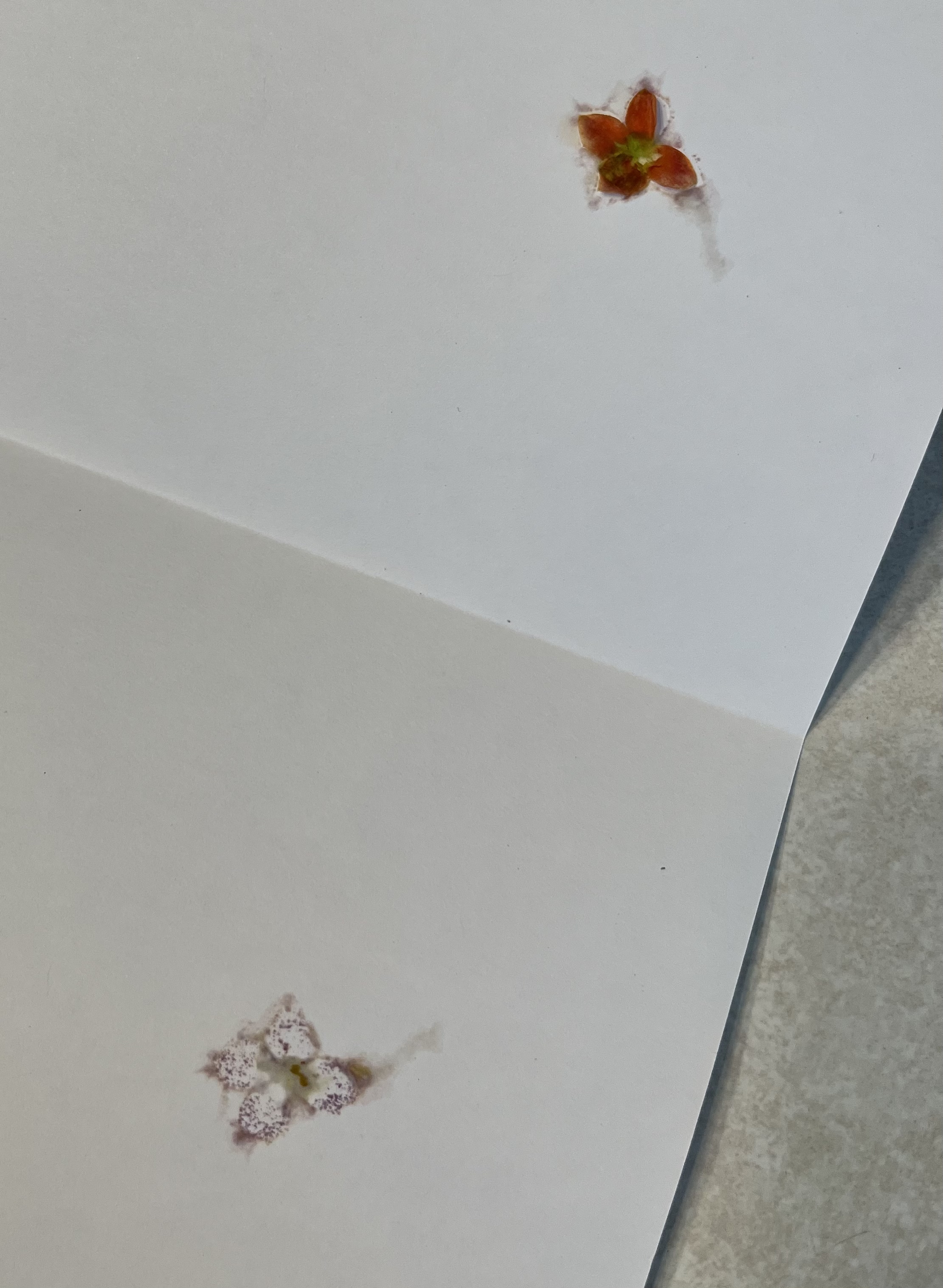
Printing with the colors of spring is a delicate process but has so many benefits for your littles. Teach them to retrieve the flower parts that have fallen already, or those that are in abundance or wilting, so as not to take away what animals and insects need :) Talk about food chains in the simplest terms and about how important all of the pieces of the chain are. 

It is also a great time to talk about having respect for growing things, and to give the plants a chance to survive and thrive. Children are capable of being very gentle and should understand their impact on gardens and wildflowers - respect for all nature! :) 


Bring paper and rolling or pounding tools (maybe from playdoh or kitchen sets) outside.  Demonstrate how to place the plant material gently between the folds of the paper and press, or pound, the color onto the paper - and then check out what you have made! The color and shape may transfer or become another shade when pressed on the paper. Very wet flowers and leaves won’t work for you, and dried leaves or plants are too brittle to transfer well. 


Trial and error (or success!) is a great practice for children, as they need to learn stamina in experimenting. Watch for students who are willing to share information and partner them with those who may need some encouragement. 

This can be a great team building experience, as you hopefully see empathy and excitement build for all the group to be successful. As children learn to work together, they can experience great self-image and feel good about cooperating. Encouraging these traits through play and creating is THE BEST! 

And, as always, have fun!


Wednesday, July 27, 2022

Modeling Quiet Time

There are so many distractions in the current world and the kiddos are WOUND UP with electronics, constant programming, sports teams .... all of which have their place.

But ... it's hard for a kiddo to find a space to relax, unwind, and just think. 

These days, grown-ups are suffering from the same "affliction," and have limited space (physical or mental) for reflection, dreaming, creating, etc. 

Telling your child to have some quiet time doesn't always help them to understand what you mean by that. Like any concept, MODELING this for your children is a critical piece of teaching them to make space for their own quiet time. 

Take some time to show your child, by example, what quiet time would look like, sound like, feel like.

  • Get comfy in a chair and read an actual paper book or magazine. Recharge and take your time, focusing on something, instead of scanning.  
  • Take a blanket outdoors with some books and writing paper (or not) and have quiet time in the shade. Enjoy the benefits of being outdoors.
  • Find a corner of the room to sit in with minimal distractions and write, diary style or free style, any thoughts you have - or doodle. 
  • Turn the lights down, put on some soft music and just let your thoughts wander. Regulate your breathing to lower your stress. 

Let yourself enjoy some quiet time, and your child will learn that this is a great time for dreaming, relaxing … and for self-regulation. Sometimes the stress of our go-go world is too much, and having tools to decompress is important. 

"Mindfulness" is a concept that has been publicized a lot in recent days. There are books, videos, audio tracks, etc. to help you on the path to mindfulness. So many folks are looking for an easier way or more time-efficient way to do things, but mindfulness (or quiet time) is not going to fit into that category. Carving out some special time to be quiet, spend time with yourself, find things that make you joyful ... this is a process.

MODEL for your children, and enjoy the side benefits of winding down and chilling out. 

Have fun!

Monday, July 25, 2022

Daily Schedule for the Win!

 It seems like such a little thing …. a visual schedule. 

Children are used to keeping to a schedule in school, and educators have long known that posting a daily schedule (and sticking to it, mostly) can help keep students on track and alleviate questions and disagreements. At home, especially if it’s the school holidays and the days are drifting by, a schedule can help with your daily routine, too. Maybe the little transitions are turning into longer transitions, with pushback, and some tempers may be starting to flare. The b-word (BORED) may be getting 

Something simple like posting a visual schedule can alleviate stress, help children make the most of their time, and ease transitions between activities. Just as in school, a posted schedule allows children to see what is coming up, how close snack or lunchtime is, and when their favorite activities are coming up. With siblings involved, it also allows for taking turns in a non-confrontational way. And, the best, the adult doesn’t have to keep tightening the reins or making decisions, and might enjoy their children more ;) 


Start with a large sheet of paper and a list of what NEEDS to happen that day. Get input from the kiddos about activities that they would LIKE to do as well. Determine chunks of time that work for the group and alternate between activities, writing out a schedule to post for all to agree upon. You can write it out yourself, add doodles or pictures, or choose something from the bounty that the internet offers. (The one shown is a free download from simplemomreview.com)


Using timers has worked for us too, to give children a way to monitor how much time they have left in a time period. Even the smaller children can visualize, by using an egg timer or countdown clock, both of which you can find online. 

Try this out and see if it works for you! 

Have fun!


Wednesday, December 1, 2021

Thoughtful/Useful Gifts for Creative Kiddos

Consumable gifts - gifts that will get used up and not take up space forever - are great for adults AND kids! Some of my favorite gifts for adults are … 

  • restaurant gift cards for a night out 
  • collections of note cards and greeting cards, wrapped up with some stamps 
  • seeds and pots to plant and nurture 
  • specialty spices/ ingredients with a favorite recipe              

…. You get the picture! 

So, why not take this concept and apply it to THE KIDS! There’s something for everyone! 

For your kiddo Mechanic:

Hit the hardware store for a collection of bolts and washers and screws and nuts to put in a small “toolkit” container and let your child have fun with this self-made STEM kit. Extra points if you find a small board and drill holes in it to work on - don’t forget to sand down those rough spots :) 

For your little Scientist:

Put together a sturdy magnifying glass (Lakeshore has some good ones) and some plastic containers with lids. These will be collection cups - put in a sample of pine cones, seeds, shells, etc. but leave lots of room for additions by your scientists.

For your budding Writers/Artists:

A box of scrapbook paper, construction paper, and sticky notes will be exciting for these kiddos. Add in scissors, glue sticks, stick-on Googly eyes, etc. and some writing tools to complete a card or book-making kit. 


For the kiddo Bakers/Chefs:

Sometimes supplies of their own inspire new hobbies! Start with a favorite recipe and add a few special utensils to create interest :) Plastic bowls and small rolling pins, spoons, recipe books, cookie cutters, and mini pans are all possibilities for baking kits. There are toy versions of baking kits or you can make your own and present it in a little cloth bag or box. 

Most of all, think of all the interaction that can take place while using these kits, and have fun planning together!! 

Happy Holidays!!


Tuesday, October 5, 2021

The Reading "Game"

When kiddos first begin to notice the printed word all around them, it is a GREAT time to tap into their natural curiosity and begin to name the letters for them to learn. Making it into a game makes it that much more fun and appealing :)

When the kiddos ask about signs or symbols, challenge them to tell YOU what it means. Follow their lead to gauge interest and start with letters that are part of their world - letters they see every day and ask about! "What does that say?"

Point out letters casually - and make the primary sound the letter makes, as well as naming the letters. This connects sounds to letters and sparks more connections and interest. 

Play games with their beginning name letters and then words that are important to them, like Mom or Dad. When the sound/letter has more meaning to them, they will likely be more interested. Interest leads to retaining information, as well.

Call attention to words in your everyday life .... Muffin! That sounds like mom at the beginning ... mom, muffin, .... what else?

******************************************************

Then, over time:

Make a word collector ... Draw boxes on a big sheet of paper or make a notebook. Add drawings or clippings from magazines with pictures of words that start with different beginning sounds.... label them and repeat them in groups, mom, muffin, mop, mountain. 

We had fun making matching cards for beginning sounds, using magazines and index cards - got in a little cutting and gluing practice, too! Car and candy are a match for beginning sounds, so are bed and bathroom! These were easy to find in brochures that came in the mail!

******************************************************

Keep the format loose and don't try to make perfect letters at first - there's time! Make sure when you do, that you are teaching them the right way - make your letters from the top ... pull down from the top to make tall or other letters (b, h, i, j, k, l, m, n, r, p, t, etc.) start with a letter c to make others (c, a, o, d, g, q). Making letters this way helps them later on, when they are learning how to write cursive.


Remember, have fun!


Tuesday, August 10, 2021

Baby Steps :)

Way before your child reaches preschool age, they are already learning ALL THE TIME from the world around them :) You are their first teacher!

There are many steps to child development, and many great resources to find out more about the different stages your child will go through. Each step is exciting, and should be celebrated, as your child begins to interact more with the world around them.

Reaching for a person or an object such as a brightly colored or noisy toy or rattle is one of the first interactive things a baby will do. It’s exciting the first time it happens, and every time after! :) Watch to see your baby track the noise or color with their eyes, or whole head, from side to side, and try to grab as their control becomes more developed.


Stretching out on a flat surface for tummy time is another important exercise for development. As babies gain control of their muscles, tummy time builds their neck and core muscles, which help with so many things down the line. 

Putting bright things or favorite toys on the perimeter of their space will encourage your child to reach and move towards the item. Get right down at their level and shake a toy or call their name - it will keep them engaged and interactive. A little tummy time for the grown-ups is a good thing, too :)

Following your lead in pursuing a toy and beginning to “army-crawl” or roll towards something, or someone, is another step worth waiting for. Your doctor will give you benchmarks that are indicators of your baby’s continued development - keep in mind these are averages :) Each of these "exercises" builds skills in your child that will help them, when it is time, to learn to sit in a group, write and draw, and attend to lessons.

Along with physical development, a child's "literacy" is developed over time, with baby steps from infancy on. Reading aloud to your child is one way to foster literacy. Your child will begin to equate story time with time for your attention, and with coziness. Showing pictures in the book, and reading with feeling, draws children into the story and helps them focus their attention.

There are many other ways to promote literacy in small children :) 

Songs and Fingerplays introduce new vocabulary and rhyme - try “Itsy Bitsy Spider” or “Twinkle, Twinkle, Little Star.” Using simple hand motions makes it more fun and easier to remember, too! If you're a little rusty, you can always YouTube nursery rhymes, and you will be amazed at what is out there. 

 Puppets are another great tool in developing speech and language literacy. Begin by having puppets "talk" to each other and when your child begins to get involved, have them take on a character, or two! Even simple one word exchanges are a step in the right direction. Acting out a rhyme or familiar story is a fun way to engage your child. I like finger puppets, as they are small enough to have a variety, and easy for little ones to manipulate. Sets of puppets that go with stories are easy to find ... or make your own, using drawings and craft sticks! 

Have fun!