Sunday, August 1, 2021

Car Games - Playing with Content

Riding in the car can be frustrating, boring, annoying .....or FUN! My riders get antsy at the end of the day, right before dinner, while we are riding home from day care, school, camp, or sports. Trying to keep the older ones engaged, and the younger ones from falling asleep, we've had great success with car games!

Their favorite, by far, is “Finding A to Z” - we start at the beginning of the alphabet, call out the letter, then find something along the way that begins with it! Some are REALLY hard, like Q (we found a quarter on the floor of the car!) or X (we let that one be an ending sound too!). You can make your own rules, of course!

“Shape Find” is another fav! One player calls out the shape of choice, while others have to find it in a sign, shapes like windows or doors, or even roof lines or wheels. You can also play this like an I Spy game. 

“I Spy” can switch to be shapes, colors, actions, etc. or a combination of these. It relies on powers of observation :) “I spy something yellow that moves…” or “I spy something that spins and is shaped like an oval …” Have fun with it! 


Longer trips may require longer games - see this post for some more ideas: 

https://makeearlylearningfun.blogspot.com/2011/07/simple-travel-games.html?m=1

Car rides are also the BEST places to get some one on one conversation time with little ones!  If you ever get a chance, ask them some open-ended questions about what they like best to eat or play with, and maybe the conversation will help you bridge to other interesting topics :) 

Have fun! 


Tuesday, May 18, 2021

Books about Waiting


It is hard to wait! If waiting is a problem for your child or your class, you may see benefits from the many tools out there. Some advocate using timers or written (or drawn) schedules, which both have their uses and can be very helpful with wait times. Transition tools, such as special songs, pausing for stretching, or counting down to activities are also very helpful. 

Don’t forget to use stories to tackle new or hard things :) Reading about others who have trouble waiting can open up great discussions and help your child develop some self-regulation tools of their own. Putting the solution partially or completely in their hands encourages “ownership” of the ideas that are generated (sometimes with a little help steering 😉). 

  Two of my favorite authors have books on this topic - and there are lots more out there! Karma Wilson’s Bear series continues with “Bear Can’t Wait!” which has Bear so impatient to have a party for a friend, that he has some problems keeping it all together! He ALMOST wrecks the surprise altogether, but some teamwork pulls it all together at the end!

Mo Willems’ book “Waiting Is Not Easy!” shows how hard it is to wait for something, especially when it takes awhile for it to happen! Piggie’s surprise is worth waiting for, and this book (like all the other Mo Willems books) is SO fun to read!


As always, books are great jumping off points for identifying behaviors and problem solving. Use the stories to make connections, start discussions, and help your children grow. 

Have fun!

Sunday, April 25, 2021

Learning Outdoors

"Why not have class outside?" Easy for them to say .... ;) But ... with some prep, it can be fun and productive!

In these continuing pandemic days (or really anytime!), as the weather gets nicer in the northern hemisphere, we can look to the outdoors to supplement our classroom space, but only if our needs can be met there for safety and security :) 

First, think about safety. Is the surrounding area conducive to having class outside? Are there too many distractions from heavy traffic or loud noises? Is it too sunny/shady? The physical position of the teacher (and other adults) and students is also important, as you want to make sure no one is out of sight or close to hazards (like streets or steep slopes).

Next, this plan takes some prep work for the teacher, instead of a spur-of-the-moment decision. Try a rolling cart or carry basket pre-loaded with all the supplies you might need. (A small white board, markers, some chalk, sticky notes, etc.) Students could have pre-made "seats,"such as folded beach towels or small pillows tied inside plastic shopping bags for avoiding dampness. Clipboards are always a great addition, making things "official" :)

Then, choose what part of your daily lesson would work best outdoors. Some topics really work in outdoor settings, such as: 

  • measurement or making patterns in math - Take your measurement tools outdoors and use objects found there to extend your lesson. Or, find natural objects outdoors to arrange and extend patterns on the sidewalk or in a grassy area.
  • growing things or force and motion in science - Take these topics outdoors and plant in the dirt or in raised containers or offer wood planks and blocks to encourage experimentation with force and motion ideas. Add a few balls or toy cars and see what theories your friends can prove.
  • poetry or descriptive writing or really any type of creative writing - Any age students would enjoy laying outdoors on a beach towel and writing/drawing about what they see/feel/hear.
  • reading aloud with discussion - This would be great, even as a last-minute idea, and can break your day up, allowing for stretching and movement, as well.
  • independent reading/paired reading (more room to spread out)/small groups - Experiment with different set-ups for reading time and spread your class out a little. Have something in mind to hold them accountable for what they are reading during this time. You may choose to pull a small group, as long as you can still monitor safety for the others.
  • art with watercolor paints, chalk, recycled sculptures, nature sculptures - There are so many art projects that can be enhanced by being outdoors, and help your children connect art and nature.
Have Fun!


Thursday, March 18, 2021

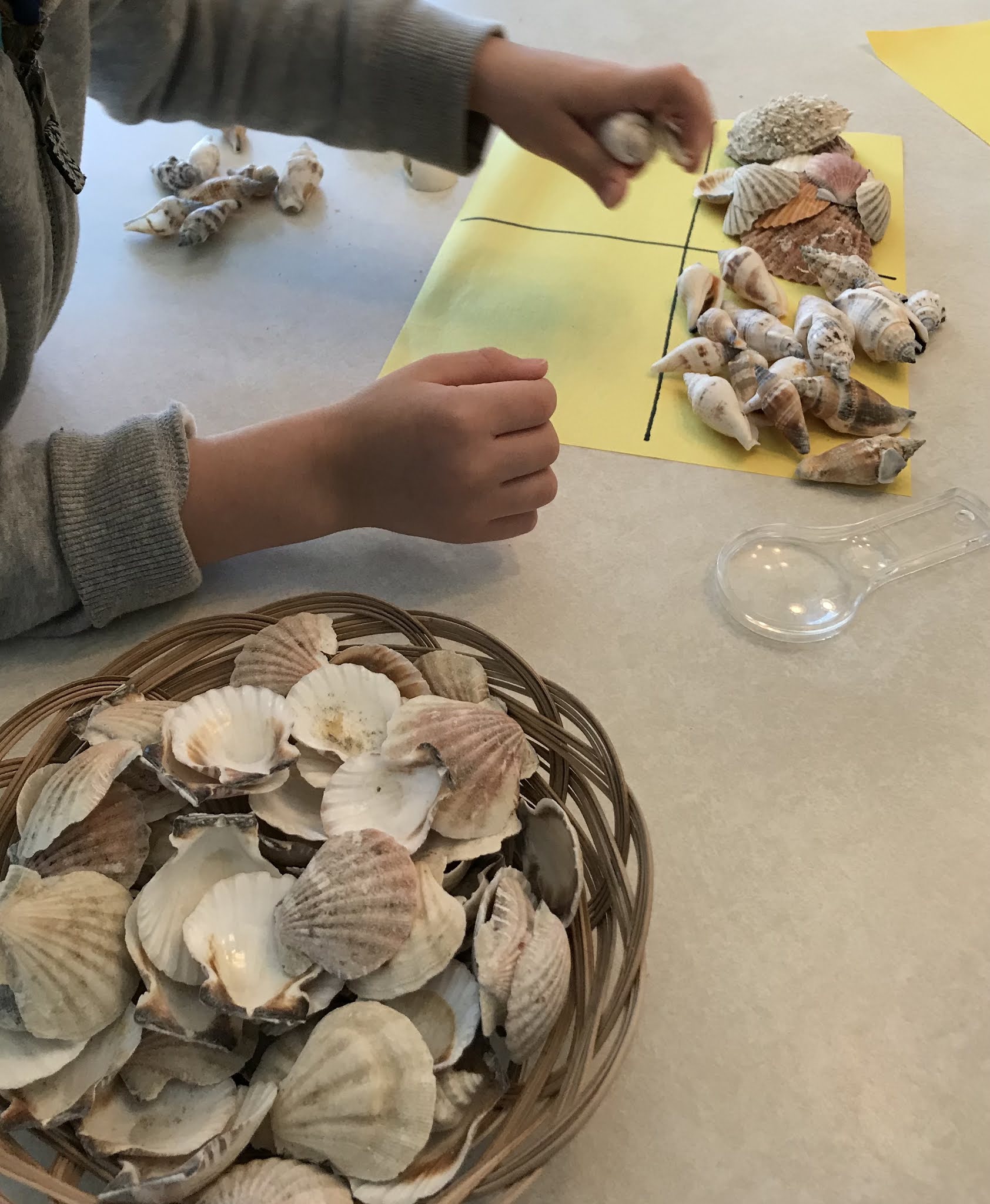
Learning with Collections: Seashells

Playthings don’t have to be expensive and manufactured to grab a child’s attention, and to learn from. Nature provides many objects to observe and tinker with, and kiddos are drawn to them. Sticks, leaves, rocks ... and don’t forget seashells! (If you already have a few around, from trips to the beach, then you’re all set! If you don’t, craft stores and discount stores often have baskets or bags of them for decor projects.)

Whether your child has never been to the seashore or has visited there lots of times, seashells seem to spark curiosity and can lead to all sorts of learning. There are many shapes, sizes, and colors of shells to be explored :)

Their first inclination may be just to look closely to see the nooks and crannies of each shell. You can help by providing tools, such as magnifying glasses and simple sorting mats. Sketching tools are great for encouraging in-depth observations, also.

“What do you notice?” is a great prompt to lead them into discussion and wondering, allowing natural scientific inquiry to take place. One kiddo here started to play with the distance from object to magnifier. “When I hold it farther away ...” and he was off checking things out :) 

They may observe fossils, shells inside other shells, or even find that two half shells that fit together. This may lead to questioning what might have lived in the shell previously. Many children might not realize that an animal had lived in the shell, and would likely be interested to find out about it.

Discussions of animal habitats and different types/shapes of shells can be supplemented by finding pictures in books or on the internet. Having books or pictures on hand is always a good idea and teaches children how to explore a topic.

Kiddos may make connections to other things they know about the sea. We had a shell with some green dried strands of what they imagined could be seaweed, knowing that seaweed sometimes was found by the ocean’s edge. Let your child question and explore ... maybe even get a pan of water to build a habitat for pretend play!

Have fun!


Saturday, February 27, 2021

Virtual “Playdates”

Are your kiddos missing their play dates with friends? While some have a sibling group, a cousins group, or a pod that they’ve quarantined with, other kiddos are looking for some interaction with classmates and friends with whom they would, in normal circumstances, be plotting play dates :) 

While you may not be ready for the real thing, the kiddos are yearning for connections! 

Virtual “meetings” can be a fun solution, if there is proper planning upfront. What came natural in “before times” may need an assist from a grown-up to get started and be successful :) But then - step aside :) 

Here are some tips for virtual success: 

Think about an ice breaker type activity to get the conversation started - maybe some silly questions or a short game they can manage themselves. 

Some suggestions: 

  • Show your favorite stuffed animal - take a few questions. 
  • Give a virtual tour of your room or play area. 
  • Play a type of the Headbanz game - draw a sketch or write down what your partner is and don’t show or tell them. (Maybe they are a turtle, or a chair, or a flower) your partner asks questions ... Am I alive? Am I an animal? Am I a thing? Am I in a house? etc. until they guess what they are :) 


Then .... 

Choose an activity that can be shared/ done parallel, and agree on activity beforehand. Get supplies together on both ends, but be ready for a spontaneous pivot if interests go elsewhere.

The kiddos in our family like to do virtual “hangouts,” where the interaction isn’t constant but it’s like you’re in the same space, so they pop in to ask a question, show something, etc., with no real expectation of a big outcome :) Keep it short or longer, depending on your kiddos :)

Some possibilities for more structured time might be: 

  • Book share - have two copies of the same book and either preread and chat about or read together (like in paired reading in school) and talk about it. Graphic stories might be fun or an interactive book where they have to find something in a picture. 
  • Legos - for big Lego fans, simply building together, screen beside screen, and showing what they make can be fun and generate conversation. Building on a theme, like vehicles or dinosaurs, could be the way to go, or just freestyling. 
  • Project share - a science activity can be shared, screen to screen, also - it could be as simple as showing off some nature finds and examining them closely. Other things might be color mixing, slime making, play dough cooking (with supervision), or water play. 
  • Cookie making - if you have time to be involved, mixing, rolling, cutting, etc. may be fun to do as a screen to screen activity. 

Think of things that draw your child in and hold their attention and then apply this to “distance friendship.”

Even something simple, like just having a snack together, will be beneficial to your child and their friend. In school, snack time is typically the time for socializing a bit, so it’s a natural time to sit and talk. Just like grownups, sometimes kiddos need some sort of construct to get started - but then, it may take off into a fun friendship-building activity! 

Have fun!  

Tuesday, February 23, 2021

Tools for Squirmy Students

Kids need to move like they need to breathe :) Teachers need kids to listen and keep their attention on lessons. These two things do NOT always go together :)

To avoid frustration in both parties, try employing some strategies that are low to no cost, but can really pay off. With a few adjustments, and LOTS of trial and error, little tweaks can be made to accommodate movement in the classroom, without it being so distracting to the student or others.

Seating Options: 

Having a small variety of alternate seating options can be beneficial. A sturdier, heavier chair works for some, while a cube chair or stool can give support for other students. Ask for donations of a rocker, stool, etc. and see what comes in  :) 

A "wiggle cushion" placed on a classroom chair can give the student a little room to move, without scraping chair legs on the floor. Rubber casters or tennis balls can be used to eliminate the scraping too :)

Sitting on a yoga ball can do the same thing, but some may need to be stabilized for safety. Simply standing up to work within a defined space for some tasks can give some students the physical stimulus they are needing, without it being a big deal. Some like roller chairs, but sometimes they can be even more distracting.

If your student is slumping over the desk or table, try turning the chair around to force a straighter spine, or using an upended cube chair, if available, to help with posture and core strength.

Tactile tools: 

For a squirmy student, try a squeezable stress ball or a small ball of Playdoh (with a quiet conversation about how this is to squeeze, not to divert attention.) Another option is a square or strip of some kind of tacky material, like Velcro, that offers a tactile stimulus, either on top or just below the edge of the child's space, that they can interact with.

Attention Tools:

Reference cards with visual cues to keep eyes on the teacher, etc. can be taped next to the child's spot or posted in the room, to be tapped quietly when the student needs a reminder. It can be as simple as a few line drawings or emojis, taped up with packing tape or laminated. Sequenced cards can help with multi-step processes like packing up, giving visual assistance to students in need of direction.

A "speaker" mascot is another tool that comes in handy - a small stuffed animal or squishy toy would work - as you quietly place it in front of the speaker of the moment. (COVID rules may require you to save this for another time.) A pretend microphone would work the same - if you are holding it, it is your turn to speak. If not, it's not! It’s a visual way for students to “see” whose turn it is :)

Movement Breaks:

Whether it's "Go Noodle," YouTube, or any other resource, there are LOTS of movement activities out there that can be used for reinforcing learning. Aside from practice, movement can also be beneficial to students' focusing ability.

Yoga poses are great for breaks, working on stretching and breathing. Look for Gorilla Yoga or a free program on YouTube.  Playing a little "Follow My Move" is also helpful, as students take turns showing a "move" and others do it in turn, counting to 5 or 10. (This is also nice when you have to switch technology or something and need the class to transition.)

Any forms of vestibular stimulation (dancing, bouncing, yoga upside-down poses) are helpful for all kiddos, especially those that aren't getting a lot of movement opportunities outside the classroom. These movements are calming and help with ability to focus. And, they're fun! 

Try something new - have fun!

Friday, February 12, 2021

Photos as a Teaching Tool

With some students remote and some present in school, educators are scurrying to find engaging ways to interact with both groups and “up” the interest factor in their lessons. 

Using photographs as tools in the classroom is not a new technique, but maybe one to revisit in this day of COVID teaching. The strategy of popping a photo up without direction and leaving feedback open-ended makes the photo a “mystery” to be solved and encourages students to “lean in” by piquing their curiosity.  

There are so many ways to do this in very different areas ...


Use photos as Story Starters, giving students an opportunity to write a sentence or story about what they see. Embed lessons about sentence structure, word choice, etc. in a back door kind of way.  


Photos can be great language builders - descriptive words are a natural ... size, color, shape, etc. Try a word web on a topic using a photo as a launch point. 


 Science topics are a terrific fit for photo use! There is nothing like a visual prompt to get everyone involved in something like space, earth science, growing things ... any topic you want. 

KWL charts can be enhanced by using a few photos to boost the interest and grab your visual learners, prompting them to participate. 


An area where real life photos is underutilized is Math! Photos of block arrangements, groups of scattered manipulatives, or partially-filled containers with a “What do you notice?” will get your students thinking, looking for groups, similarities and differences, shapes or whatever else they come up with. They will begin to view math as a part of the everyday world. Great discussions and lessons can ensue! 


The BEST part is that, using technology, ALL of your students can see these photos at the same time and can feel that engagement of learning and exploring something new. A puzzle or mystery to be solved is sure to grab their attention.


Use photos as transition tools or do it just for fun, but toss a little learning in along the way ... What words can you make with these letters?

What do you see on these picture cards? Matches? Sizes? Lots of math concepts here ...


Have fun!